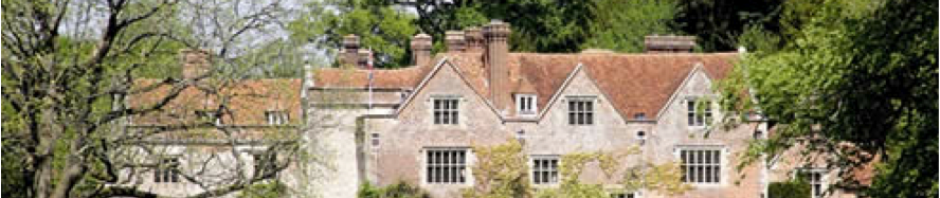

Well beyond the reach of the 1666 Great Fire of London, which destroyed so much of Tudor London, is an amazing survival, Canonbury Tower, rearing above the fine late neoclassical terraces that surround it. It is very rarely open to the public, and our private view takes place only with the special permission of its owner the Marquess of Northampton, so we feel very privileged.
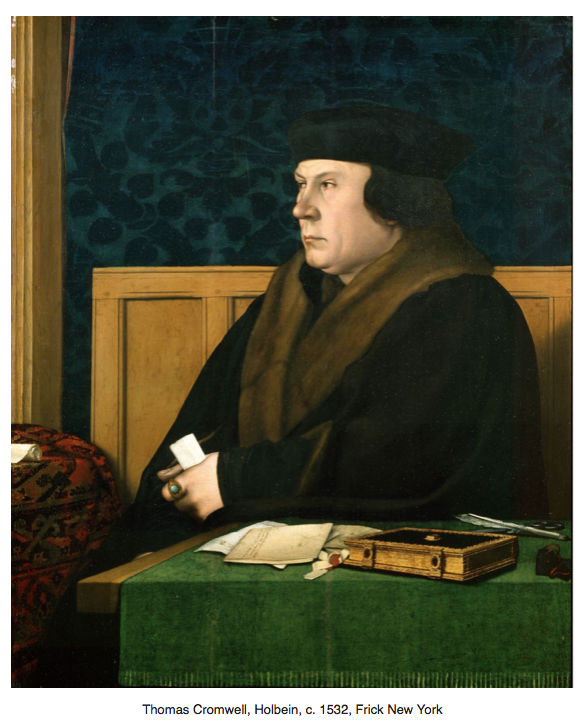
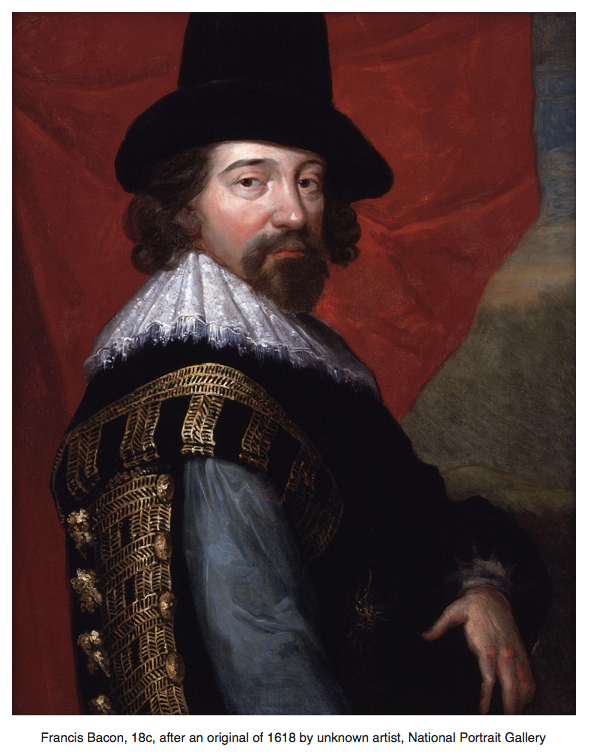
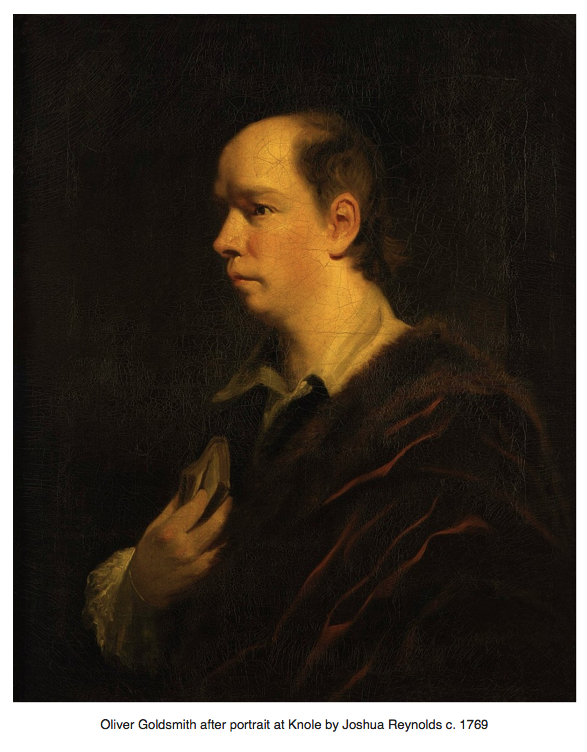
Canonbury Tower’s significance goes beyond its survival and its fine panelled rooms. Its occupants form a remarkable family of writers, politicians, thinkers and writers. Thomas Cromwell lived here before his execution in 1540. Francis Bacon, essayist, scientist, Rosicrucian and Lord Chancellor lived here, where the air was sweeter than in the swamps of Jacobean London. Irish playwright Oliver Goldsmith wrote here, possibly to escape his creditors. Charles Dickens wrote a Christmas story about a lamplighter in Canonbury, which features the Tower.
Nor are they the only writers who were drawn to Canonbury. Regency Canonbury Square, described as the most beautiful square in London, was not always so genteel. Indeed when Evelyn Waugh lived at no. 17a and wrote his first two immortal novels Decline and Fall and Vile Bodies here, he described it as “half a house in a slum” and “our dilapidated Regency Square”. When in the 1940s George Orwell and his wife Eileen Orwell were bombed out of their previous flat and moved to No. 27b in the autumn of 1944, he wrote of “the decaying slum in which I live”. ‘Animal Farm’, no less, was published in 1945 while he was living in the square; he remained there with his wife and child until his death in 1950. The painters and designers, Duncan Grant and Vanessa Bell, lived at no. 26a during the 1950s.
We adjourn to The Marquess Canonbury for a fine optional pub lunch with readings by Nicholas from the writers who lived in Canonbury Square.
10.45 for 11.00 am Meet at Canonbury Tower, a 10-minute walk from Highbury and Islington station. Maps will be provided.
12 noon A literary walk with frequent pauses round Canonbury Place and Canonbury Square
1:00 pm optional lunch in The Marquess Canonbury, a short walk from Canonbury overground station, Essex Road main line station, Highbury&Islington tube station.
2.15 pm Day ends.
Cost: £100 members, £110 non-members, including private access fee to Canonbury Tower.

Verulamium, the Roman city that preceded medieval St Albans and its Cathedral was by no means an isolated incidence of an important Roman city. At the junction of what are now called Akeman Street and Watling Street, it was connected to the great network of Roman roads leading directly to Cirencester, Bath and Chester, and via London to Colchester, Dover via Watling Street, Chichester via Stane Street, and Dorchester via Portway. Each of these towns, including London with its 60,000 inhabitants, could be seen as satellite cities of Rome.
These roads can be compared to air routes in the modern day. Just as a modern business traveller can go to any airport in the western world and find roughly the same layout, check into any business hotel and find one room, gym or swimming pool very like another, and go to any shopping street and find the same shops, so a Roman traveller could go between these towns at a rate of about 20 miles a day and find the roads would be to the same standard, and in each destination town could be found a forum, basilica, market place and bath house, if not an amphitheatre, just as would be the case in Rome.
An astonishing wheel of Roman roads led, and still leads, out of London, because the hub of the wheel is, of course, London, ‘Londinium’, the capital of Roman Britain for most of the Roman rule. They are the roads on which much of our modern road system is based, running clockwise from the A1 (Ermine Street) to the A2 (Watling Street) to A3 (Stane Street), A4 and A5 (Watling Street). London had six city gates of Roman origin.
The longest of these direct journeys from Verulamium would have been that to Chester, ‘Deva Victrix’, home to the 20th Legion and crucial to defences against Wales, a journey of about a week. Chester was a military garrison, and its amphitheatre, the largest to be discovered in Britain, was probably used for military training.
Colchester, ‘Camulodonum’, with a castle on the site of the Roman Temple of Claudius also has a Roman theatre, mentioned by the Roman historian Tacitus when describing the sack of the town by Boudicca. The town was quickly rebuilt with massive defensive walls which can still be seen: they are directly comparable to those at Verulamium. A superlative bronze sculpture the Colchester Mercury gives an idea of the sophistication of Colchester culture.
At Dover, ‘Portus Dubris’, the British port closest to the Roman Empire, was a thriving town said to have covered at least a five hectare area. A Roman lighthouse, one of two, survives almost at its original height of 80 feet. There are Roman wall paintings still extant, which have given Dover the title of ‘England’s Pompeii.’
Chichester, ‘Noviomagus Reginorum’, gives the best idea of domestic life in Roman Britain with the bathhouse, originally 5000 sq metres in size, a place to gossip and do business daily, and an opportunity to express Roman ‘cultus’, the cult of bodily cleanliness. The amphitheatre survives as does some exposed mosaic on the floor of Chichester cathedral and large quantities of flat glass signalling the presence of windows. At Fishbourne, the remains of a Roman villa includes the largest collection of Roman mosaics in Britain.
In Dorchester, ‘Durnovaria’, in 1937 archaeologists stumbled upon a 4th century Roman house at Colliton Park, which has now become the only complete excavated Roman house in the country, equipped with a beautiful mosaic floor. Dorset County Museum, where Nicholas began his career, is one of the finest small archaeological museums in the country. Nicholas claims responsibility for the poor quality of restoration of the mosaic there.
The final spoke in this particular wheel ends in Cirencester, ‘Corinium’, with one of the largest amphitheatres in Britain built in the early 2nd century. The Roman city was second only to London in size and importance with a population of over 10,000, a forum, and a basilica. It was located at a junction where all the major roads meet. Its Corinium Museum has a very fine and extensive collection of Roman artefacts.
By setting Verulamium in the context of the intentionally linked Roman towns, this Zoom lecture and discussion aims to examine how Roman Britain was planned and constructed to prosper. What is particularly remarkable about the Roman occupation of these islands is that Britain was at the far borders of the Empire. Prior to conquering Britain, the Roman Empire focussed on the Mediterranean area. Nevertheless, over the course of 400 years, Romano-Britain succumbed to the Roman genius for transforming the lands and people it conquered so that it was inhabited, not only by Romans from the Empire, but Romano-British people who quickly adapted to what they saw were the advantages of the Roman system: its transport infrastructure, its connections between cities and the comforts and distractions provided to them.
£ 55 Members, £65 non-members
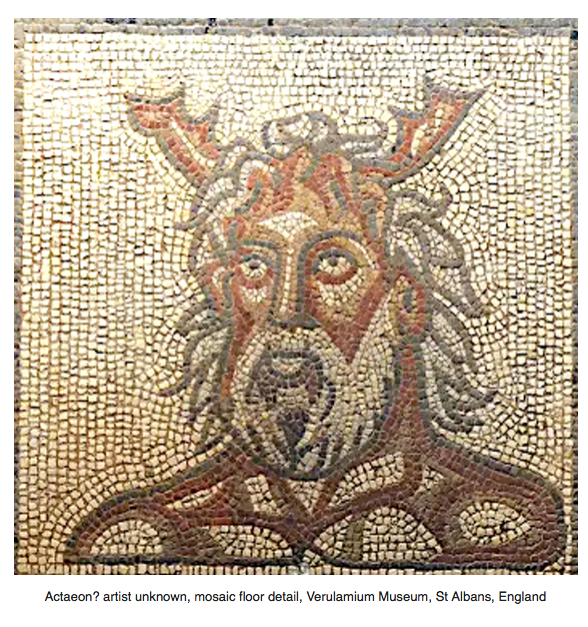
St Albans has more than its fair share of superb material evidence of Britain’s long history! Known in modern times for its Cathedral, it tells a story of domination of the land and the people by King as well as by Church sometimes in competition with one another to control the people they both were dependent upon. Early Christian fathers and their flocks no doubt first occupied smaller Roman structures, centuries before the building of enormous structures like cathedrals. Many of those simpler more ancient structures remain far below ground level today along with most of Roman St Albans.
Our visit will take place in an area just southwest of the modern city of St Albans, now a scheduled monument. It is the site of Verulamium, once one of the largest of the important cities of Roman Britain. Their museum is a gem.
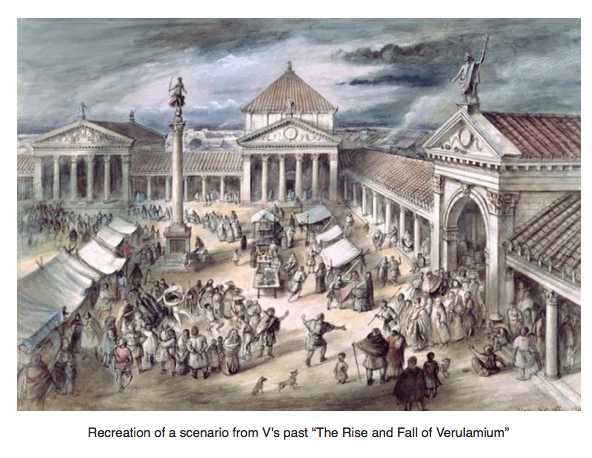
The pride and grandeur, even culture, of ancient Rome would have been more than evident throughout the city. Though a large portion of the city remains unexcavated, as park and agricultural land, what is visible is quite astounding evidence of Verulamium’s prominence in Roman Britain. Though sacked by Boudicca in 61 AD, Verulamium recovered quickly. We are left with evidence of quite extraordinary prosperity of the 2nd-3rd CE, the age of the Emperor Hadrian, and, his immediate successors. There is more than enough to see from those nearly four hundred years of occupation that there is no doubt Imperial Rome was very rich and very proud of its reach!
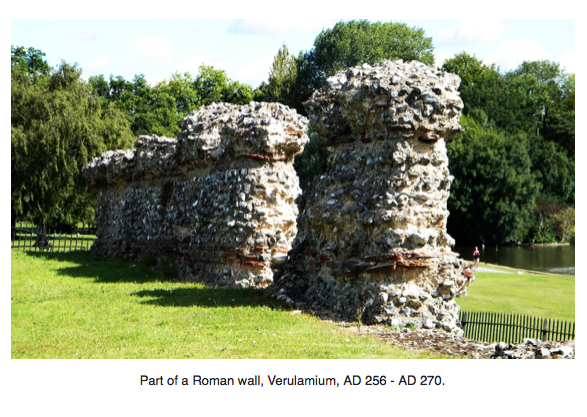
The major remaining segments of a mighty Roman wall indicate the significance of Verulamium. Parts of the structure are four metres high, and fascinating to compare with the abbey church, built 800 years later, in exactly the same materials of flint and brick. The church builders recognized what would ensure and assure their legacy!
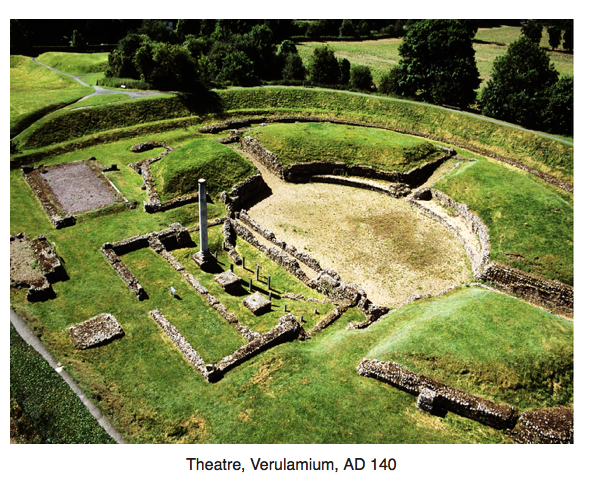
But the mighty walls are by no means all that survives. Here to astonish us is the only Roman Theatre to survive with its stage in England: all the more remarkable for NOT being an amphitheatre, but a theatre with a stage, which is still in use today – 1800 years after Roman actors first enunciated Seneca, gladiators grunted, and lions roared from the pit!

In the lovely little museum, superb reconstructions of colourful Roman rooms, and the Sandridge hoard of Roman gold coins, share space with 49 superlative original mosaics. A short wander through the park is a superb mosaic housed in an intriguing small modern building. It displays a ‘hypocaust’, an underfloor space through which heat passes from a furnace to heat the floor or bath, or both above. It is the perfect and most vivid example of the sheer genius of Roman engineering and plumbing!
SCHEDULE FOR THE MIDSUMMER MORNING
10.21 Train departs St Pancras
10.41 Arrives St Albans City Station Nicholas will meet you outside and take you by taxi for coffee (optional) in Kingsbury Mill.
11.15 Short walk (5 minutes) to Verulamium Museum
12.00 Short walk to Hypocaust (10 minutes) and in-situ mosaic
12.30 Short walk (10 minutes) back to Roman Theatre
1.15 Lunch (optional) in the Inn on the Park just next to Verulamium Museum
2.30 Taxis back to station
Cost £90 members, £100 non-members, including entry fees, taxis, excluding optional lunch.

St Albans’ illustrious Scriptorium produced illuminated manuscripts of such distinction, some were spared the bonfires at the Dissolution of the Monasteries. Instead, they may have been hidden away to then be widely collected after the Reformation. They now occupy places of honour in the British Library, the Bodleian Library in Oxford and Corpus Christi’s Library in Cambridge. They include the utterly remarkable 13c History of the English, and the Life of St Alban, by one of the earliest named and greatest, of English artists, the St Albans monk, Matthew Paris.
We study these and other treasures by means of modern technology with a Zoom lecture in concert with our visit to St Albans Cathedral, or attended for its own sake. These illuminated manuscripts are amongst the most vividly coloured, imaginative, and earnest illustrations of text that can be seen anywhere in the world. While ensconced in the most comfortable seat in the house, a drink of some sort in hand, nibbles close by, please join us for an hour with the creations of devoted monks whose religious fervour inspired and immortalised this rare art form.
These books are among our most important cultural artefacts from the period between the Norman Conquest and the Tudor Reformation. They hold the original record of our history which inspired Shakespeare, which has since become rooted in our collective memory. ’Professor James Clark of the University of Exeter
£ 55 Members £65 non-members

Amwell Spring (Emma’s Well or Emmewell in the Domesday Book) in Hertfordshire, is the ancient site of a spring from which local Iron Age inhabitants and hill fort defenders drew drinking and cooking water. Since that earliest of times, the spring has produced drinking water at the rate of 220 million litres a day for London’s thirsty inhabitants!
How the water was conducted twenty miles from the spring to London along the New River- neither new nor a river – is a most interesting tale. Most simply put, a water supply aqueduct was begun in 1604, and completed in 1613. It was called the New River; its purpose was to bring water to London. The New River took, and still takes, a course via Cheshunt and Enfield and King James I’s palace at Theobalds (the King was sure to take a share of the profits) terminating near Clerkenwell, Islington, at New River Head, just next to Sadlers Wells Theatre on Rosebery Avenue. Subsequently, the site became the headquarters of the New River Company, the owners of the New River, and of its successors, the Metropolitan Water Board, the Thames Water Authority and Thames Water plc.
We begin our day in an impressive modern building at New River Head. Here, relocated, is the marvellous 17th century Oak Room, where the Directors of the New River Company held court. It is considered the finest room of its date in London with brilliant carvings by Grinling Gibbons and his pupils. The furniture consists of superb examples of elegant 18c furniture by George Seddon. The ceiling plasterwork is splendid and a delight to study in person. Surrounding Henry Cooke’s painting of William III, the plasterer has included images of the then lovely villages through which the New River ran. It makes a charming meditation for those stuck to their chairs during dull board meetings!
We visit sites associated with New River Head nearby before taking a 341 bus up to near St Pauls Road, a 20 minute journey, from which we wander down a well-maintained path beside the New River through charming undulating little parks until a mile later we reach the statue of Sir Hugh Myddelton, entrepreneur of the New River, at Islington Green. Walking poles are welcome!
We take an optional late lunch nearby at the brilliant restaurant Ottolenghi Islington before drawing our day to a close.
SCHEDULE FOR A HIGH MIDSUMMER MORNING
10.15 for 10.30 Meet Nicholas at Fox Court Garden Café, Sadlers Wells for coffee (optional). Sadlers Wells is 7 minutes walk from Angel Station.
11.00 Private visit to Oak Room New River Head building, Islington, old HQ of Thames Water, next to Sadlers Wells.
11.30 Visit other sites at New River Head: the medieval Devil’s Conduit, the base of an 18th century windmill, and the larger 18th century engine house which once accommodated steam pumping engines.
11.50 Take 341 bus up towards St Pauls Road.
12.15 Walk a slow mile back down New River path to Islington Green.
1.30 Lunch (optional) at Ottolenghi Islington
3.00 Day ends.
Cost £100 members, £110 non-members, including coffee, donation to Oak Room maintenance fund, excluding optional lunch.
Sometimes we miss evidence of England’s extraordinary history that sits right on our doorstep. A good example, less than 25 miles from central London, is a most exemplary ancient Abbey Church, now Cathedral, of St Albans. Set on the hill where the first recorded British Christian martyr was beheaded in the 4th century, it is surrounded on one side by a beautiful sloping greensward above the river Ver, and on the other by the town that was built to accommodate the flood of pilgrims to its saint’s shrine. Many of the original inns still stand, their timbers bending and curving their way above the narrow streets as if still responding to the tread of pilgrims’ feet. This irrepressibly picturesque and ancient place is St Albans.
Even those who may be a little jaded with visits to cathedrals, or who may think they’ve seen all there is to be seen or understood in them, will be taken by surprise by St Albans Cathedral. Where else can you see such an extraordinary achievement of a brick crossing tower built in 1077 with Roman bricks filched from the derelict Roman town down the road? The ONLY such brick Norman crossing tower still standing in England, it appears all the more remarkable once you hear how the cathedral survived earthquakes, ferocious storms and more!
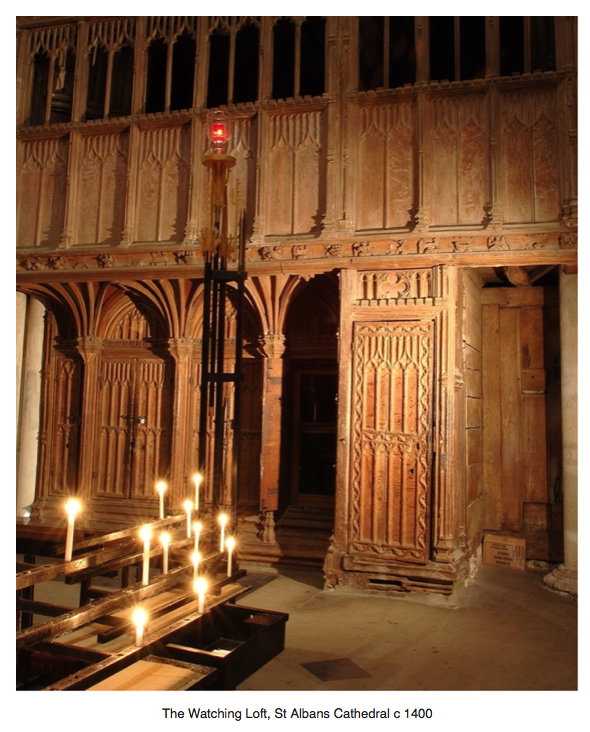
Where else can you see a stomping Norman nave – the longest in England – whose elephantine columns are offset by delicate, ghostly 13c figurative frescoes? Where else can you see a Lady Chapel still with its Edenic and undamaged profusion of 14c stone-carved floral capitals echoing a vision of a fragrant flower-bedecked heaven awaiting us? Where else can you come close to the presence of the 15c pilgrims visiting the saint’s shrine – each desperate for the spontaneous healing of painful ailments only the saint could provide? We can stand where the pilgrims would have gathered below a carved fan vaulted timber ‘watching loft’ adjacent to the shrine. There, stern monks stood guard – as if Yeomen of the King’s Guard – from first floor window openings. From high above the shrine floor, they scrutinised the crowd below easily spotting an unruly pilgrim or two, and order their immediate removal.
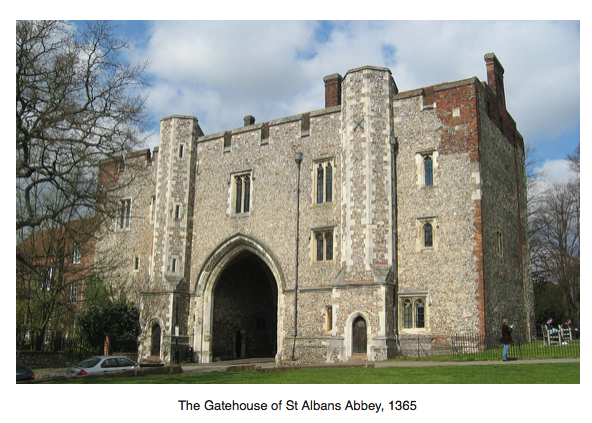
Outside the Cathedral stands a 14th century flint and brick gatehouse to a 10th century Abbey complex. Its monumental girth indicative of the size of the original abbey building. So close to London, it would have played a key role in medieval ecclesiastical affairs.
In 1479 the Abbey received one of the first printing presses in Britain. Located within the Gateway, a medieval workshop printed and distributed both secular and religious publications. Fortunately, much remains of their creativity, patience and devotion.
The historic core of the gatehouse, the 10th century core, is the original monastic school of the Abbey. Of continuing vitality today, St Albans School proudly carries on educating young men and women for important roles in society – it is one of the oldest independent schools in the world.
Up the High Street is the ancient Market Place, founded in 860 by Wulsin the sixth Abbot to provide the Abbey with much needed funds from rents. England’s only surviving medieval town belfry in the Clock Tower, which announced for the first Battle of St Albans in the ‘Wars of the Roses’, still dominates the Market Place.
Only 20 minutes from St Pancras station, St Albans is now a vibrant north London community firmly anchored to land and time by its cathedral. After our study morning we will adjourn to the cheerful café recently opened within the Cathedral’s handsome new Welcome Centre. Lunch is completely optional, but, desirable, many, including Nicholas, seem to find!
SCHEDULE FOR MIDSUMMER’S MORNING STUDY
10.06 Train leaves St Pancras
10.24 arrives St Albans City station (NB: NOT St Albans Abbey station, for which trains leave from Euston, take much longer and involve a change!) Meet Nicholas outside. Car drivers can park in the station car park or in a city centre car park.
A short architectural walk, with many pauses, through medieval streets of St Albans to the Cathedral grounds, begins from the station onward. Walking poles welcome!
11.15 arrive St Albans Museum for coffee (optional) and brief view of Assembly Room and display on St Albans history.
12.15 Arrive Saint Albans Cathedral
1.30 Lunch (optional) in Welcome Centre Café
3.00 Walk or taxi back to St Albans City station
Cost £90 members, £100 non-members,, including donations.
Booking Information:::::::::::::::::::::::::::::::::::::::::::::::::::::::::::::::::::::::::::
The Midsummer Programme 2024 has been developed by Louise Friend and will be presented by Nicholas Friend. It will be presented by Nicholas Friend. Cheques are not a viable option at this time. Instead, please make your payment to Friend&Friend Ltd by bank transfer to our account with Metrobank, bank sort code 23-05-80, account number 13291721 or via PayPal to nicholas@inscapetours.co.uk, or credit/debit card by phone to Henrietta on 07940 719 397. She is available Tuesdays 10-12 and 2-5 pm or Thursdays 10-12 and 2-5 pm.
How to Set Up a PayPal account::::::::::::::::::::::::::::::::::::::::::::::::::::::::::::::
Click on this link: https://www.paypal.com/uk/home
In the upper right-hand corner of the screen, click “Sign up.”
On the following screen choose “Personal account” and click “Next.”
On the next page, you’ll be asked to enter your name, email address and to create and confirm a password. When finished, click “Next.”
Click “Agree and create account” and your PayPal account will be created.
How to Connect your Bank Account to your PayPal account:::::::::::::::::::::::
Log on to your account and click the “Wallet” option in the menu bar running along the top of the screen.
On the menu running down the left side of the screen, click the “Link a credit or debit card”.
Enter the card information you wish to link to your PayPal account and click “Link card” for debit card.
How to Send Money::::::::::::::::::::::::::::::::::::::::::::::::::::::::::::::::::::::::::::::::
Log on to your account. Click Send & Request.
Enter the email address of the person you wish to send money to: nicholas@inscapetours.co.uk
Type in the amount you wish to send, click continue then press ‘Send Money Now’.
 INSCAPE CULTURAL STUDY SOCIETY