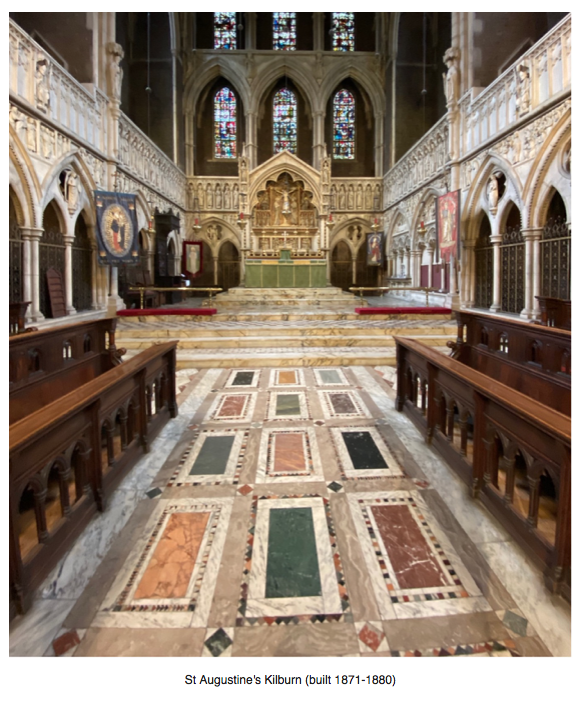
St Augustine’s Kilburn has to be one of the best-hidden of ecclesiastical treasures in London. Only open to the public on weekends, its High Victorian Gothic riches, surmounted by a superlative spire, are unexpected in this rich multicultural corner of Northwest London. It is quite simply one of the finest Victorian churches in these islands, and one of the least known.
Designed by John Loughborough Pearson (designer of the magnificent Truro Cathedral) in 1871, it takes the breath away with the majesty of its 253 feet-high spire and the richness of its decoration in colourful marbles, superb stained glass, and painted frescoes by that most proficient and prolific late 19c stained-glass and painting workshop, Clayton and Bell. The structure was inspired by Albi Cathedral, its marbles would do justice to Venice, the frescoes to Umbria, and Thomas Nicholls’s sculptures in marble and alabaster to Florence. The mosaic pavement and the embroidered banners are ‘unequalled in any English church of this period’, declares Simon Jenkins. The glorious mosaic pavement approaches the finesse of that by Cosmati in Westminster Abbey, and the banners can be compared to ancient English altar-frontals.
Designed all-of-a-piece, the decoration has been curated in accordance with a distinct agenda: from the Creation in both sculpture and a magnificent stained glass rose window at the West End, via the miracles of Jesus in fresco topped with sculpture of Old Testament prophets in the nave, and through to the Passion and Crucifixion in the Chancel. The aisles are equipped with most beautiful windows by Clayton and Bell devoted to British saints. St Michael’s chapel in the north aisle, no less superbly decorated, has the theme of musical angels, prophets and kings, their imagined notes echoing off another glorious mosaic floor. Giles Gilbert Scott added fine reredoses and Stations of the Cross in 1930.
But this is not all that is remarkable in this corner of London. Not far away is the Tin Tabernacle, a simply extraordinary survival of a prefabricated church, of a kind often called ‘iron churches’. This one was built to last five years and has lasted 160. They became popular from the late 19th century up to the start of the First World War. They were still being built in the 1920s and 1930s. The surge of iron churches led famous designer and artist William Morris to complain that they were ‘spreading like a pestilence over the country.’
The Tin Tabernacle Kilburn has been through many transformations, and the most remarkable is its currently being magicked into a ship. Not a ship at sea, but one designed to prepare young students for a life at sea. It was taken over by the Sea Cadets in 1949 as the stationary training ship Bicester, and is kitted out with blue steel portholed doors and a gun placed at the east end as if that were an object of worship. It is truly another of the wonders of London.
We begin our morning with coffee in the Tin Tabernacle, kindly provided by volunteers there, then a study of its utterly bizarre naval interior, followed by a visit to the soaring, literally inspired, majesty of St Augustine’s.
We take lunch (optional) in another peculiarity of the area, the Carlton Tavern, on the edge of the recreation ground where Roger Bannister became the first man to run a mile in 3:59.4, faster by a smidgen than the previous record of 4 minutes. It’s a tavern with a peculiar twist in its story. When this fine work of 1920’s architecture was brutally bulldozed in 2015 such was the outcry that the entire building, down to its lettering, its fine tiling and every brick, was patiently rebuilt under the direction of a local architect. It has a fine reputation for its food.
SCHEDULE SUMMARY
11:15 Please meet outside the entrance of Kilburn Park Underground Station (Bakerloo line). Those coming by car will find parking on Cambridge Gardens. Maps will be provided on request.
£85 members, £95 non-members, including coffee and donations to both churches, excluding lunch. Restricted to 15 members.
Booking Information:::::::::::::::::::::::::::::::::::::::::::::::::::::::::::::::::::::::::::
The North London Cathedral & Tin Tabernacle has been developed by Louise and Nicholas Friend. It will be presented by Nicholas Friend. Cheques are not a viable option at this time. Instead, please make your payment to Friend&Friend Ltd by bank transfer to our account with Metrobank, bank sort code 23-05-80, account number 13291721 or via PayPal to nicholas@inscapetours.co.uk, or credit/debit card by phone to Henrietta on 07940 719 397. She is available Tuesdays 10-12 and 2-5 pm or Thursdays 10-12 and 2-5 pm.
How to Set Up a PayPal account::::::::::::::::::::::::::::::::::::::::::::::::::::::::::::::
Click on this link: https://www.paypal.com/uk/home
In the upper right-hand corner of the screen, click “Sign up.”
On the following screen choose “Personal account” and click “Next.”
On the next page, you’ll be asked to enter your name, email address and to create and confirm a password. When finished, click “Next.”
Click “Agree and create account” and your PayPal account will be created.
How to Connect your Bank Account to your PayPal account:::::::::::::::::::::::
Log on to your account and click the “Wallet” option in the menu bar running along the top of the screen.
On the menu running down the left side of the screen, click the “Link a credit or debit card”.
Enter the card information you wish to link to your PayPal account and click “Link card” for debit card.
How to Send Money::::::::::::::::::::::::::::::::::::::::::::::::::::::::::::::::::::::::::::::::
Log on to your account. Click Send & Request.
Enter the email address of the person you wish to send money to: nicholas@inscapetours.co.uk
Type in the amount you wish to send, click continue then press ‘Send Money Now’.
 INSCAPE CULTURAL STUDY SOCIETY