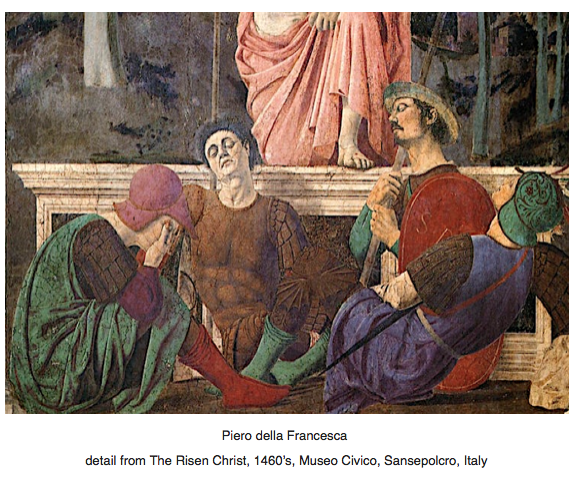
Giorgio Vasari, writing in his Lives of the Artists of 1550, lamented that Piero della Francesca (1415/20-1492) had the “truly unhappy” fate of being “robbed of the honour that is due to his labours”. Many of the early Renaissance painter’s “beautiful pictures” were destroyed in the wars of Urbino, the renovation of Ferrara’s ducal palace and the redecoration (by Raphael) of the papal apartments in Rome. Only 22 panels remain. Indeed, his esteemed reputation lapsed for several centuries. He was essentially swept into the margins of art history along with other 15c painters who were seen as primitive compared to the glorious Raphael whose work inspired art academies in Italy and across Europe.
Rediscovered in the late 1800’s by French artists such as Seurat, Puvis de Chavannes, and others (Degas and Balthus both made pilgrimages to the frescoes in the Basilica di San Francesco in Arezzo), Piero seems to have fulfilled Vasari’s belief that “time, who is called the father of truth, sooner or later makes manifest the real state of things”. It is only today that we have begun to appreciate his immense contribution. With his unique background in mathematics, he gave a touch of reality to his works, shying away from the conventional gold backgrounds, in adding convincing landscapes and architectural forms which would give perspective and add depth to these images.
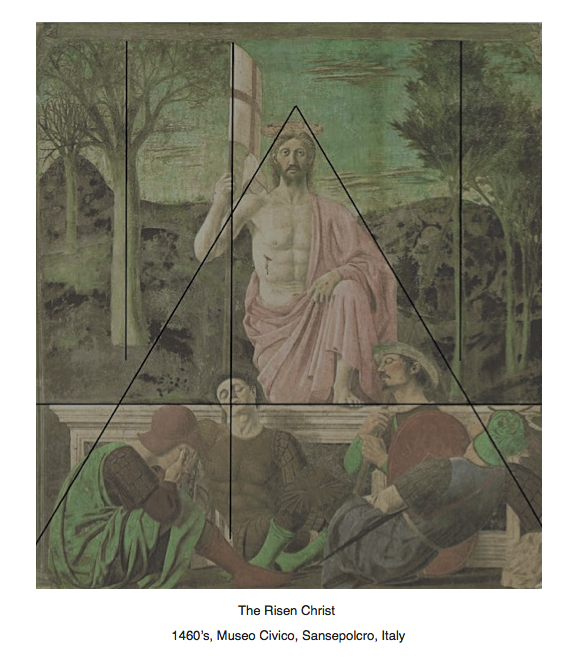
As an early Italian Renaissance painter, Piero della Francesca’s paintings were characterized by a rare and serene humanism as seen in the expressive faces and postures of many of his most carefully realised figures. Also noteworthy are his precise and tightly controlled geometric compositional forms, and his confident use of perspective. His colours are exquisite, derived from the purest of organic pigments bound together with egg.
Piero’s masterpieces deserve celebrating anew as prescient art forms as well as literary and poetic expressions with legible narratives and multiple interpretations. They stand alone as icons – powerful vehicles for spiritual uplift by true, undecided or hopeful believers alike. Please join us for this time-machine armchair visit to Tuscany in the 15th century!
Booking Information:::::::::::::::::::::::::::::::::::::::::::::::::::::::::::::::::::::::::::
Cost for a two session course £96 members, £106 non-members.
Piero della Francesca has been developed by Louise Friend and will be presented by Nicholas Friend.
It will be presented by Nicholas Friend. Cheques are not a viable option at this time. Instead, please make your payment to Friend&Friend Ltd by bank transfer to our account with Metrobank, bank sort code 23-05-80, account number 13291721 or via PayPal to nicholas@inscapetours.co.uk, or credit/debit card by phone to Henrietta on 07940 719 397. She is available Tuesdays 10-12 and 2-5 pm or Thursdays 10-12 and 2-5 pm.
How to Set Up a PayPal account::::::::::::::::::::::::::::::::::::::::::::::::::::::::::::::
Click on this link: https://www.paypal.com/uk/home
In the upper right-hand corner of the screen, click “Sign up.”
On the following screen choose “Personal account” and click “Next.”
On the next page, you’ll be asked to enter your name, email address and to create and confirm a password. When finished, click “Next.”
Click “Agree and create account” and your PayPal account will be created.
How to Connect your Bank Account to your PayPal account:::::::::::::::::::::::
Log on to your account and click the “Wallet” option in the menu bar running along the top of the screen.
On the menu running down the left side of the screen, click the “Link a credit or debit card”.
Enter the card information you wish to link to your PayPal account and click “Link card” for debit card.
How to Send Money::::::::::::::::::::::::::::::::::::::::::::::::::::::::::::::::::::::::::::::::
Log on to your account. Click Send & Request.
Enter the email address of the person you wish to send money to: nicholas@inscapetours.co.uk
Type in the amount you wish to send, click continue then press ‘Send Money Now’.
 INSCAPE CULTURAL STUDY SOCIETY