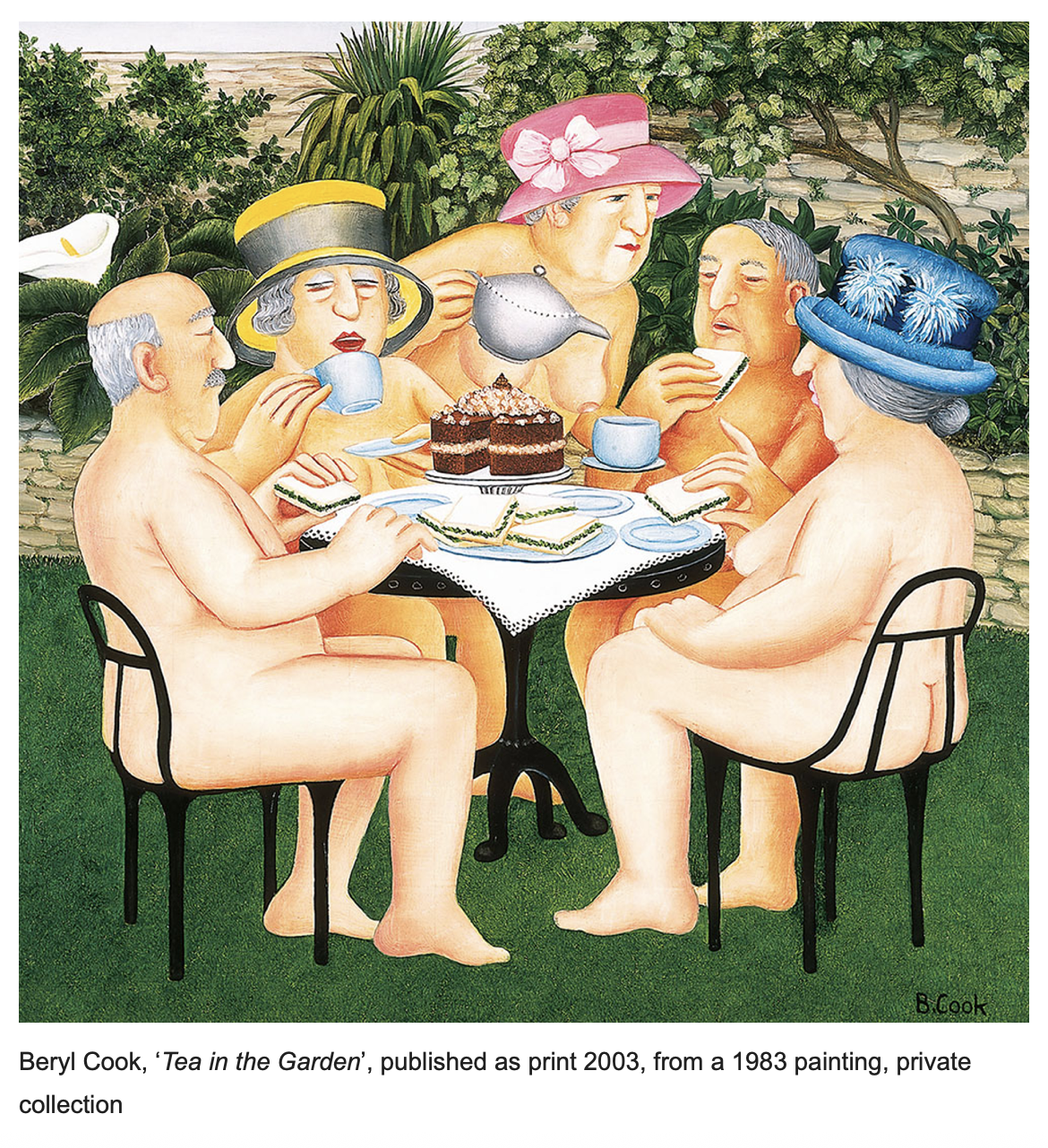
Beryl Cook OBE, though innately a private person, took huge delight in joyously committing to paint her observations of British humanity as the landlady of a Plymouth holiday guest house. Her numerous books have made her readers laugh out loud for the past fifty years. Her actual work is held by major collections; each painting makes us explode with laughter as well as admiration for her deep, touching affection for her subjects.
We set her work alongside that of her fellow female comic geniuses: Posy Simmonds of the Guardian, Rose Wylie, whose work is currently exhibited at the Royal Academy, and Sue MacCartney Snape of The Telegraph whose cartoons brilliantly satirise the many eccentricities of the British upper classes. It is fascinating to see how with each artist the female gaze recognises the nuances of human behaviour and does so without the savagery sometimes evident in the gaze of their male counterparts.
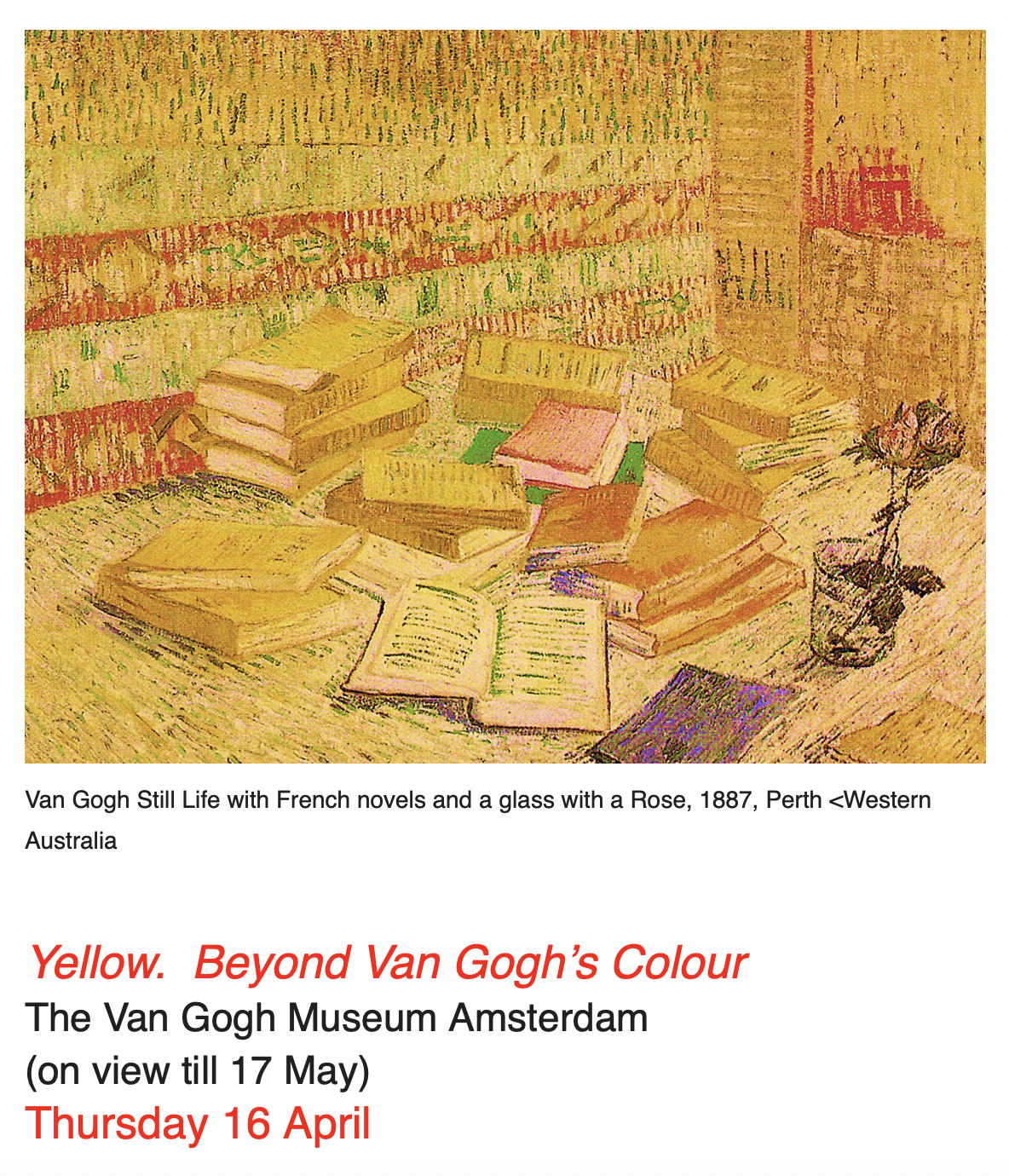
Amsterdam’s Van Gogh Museum has curated a most unusual exhibition encouraging us to look again at Van Gogh. ‘Step up, take a closer look at these familiar paintings and not-so familiar ones. For this is the first exhibition designed and curated any where in the civilized world to specifically look at the colour ‘yellow.’ The spotlight is definitely on Vincent Van Gogh, undeniably a master who revels in colour. But this time his work will be joined by others, some his contemporaries, some not, but themselves masters and mistresses in their use of yellow in their own works. This marvellous exhibition includes works by Turner (who is rumoured to have died with the words ‘The Sun is God!’ on his lips!), Manet, Kandinsky, Chagall, and Hilma af Klint, other astounding colourists who each used yellow to communicate their most profound and sincere feelings.
In February 1888 he abandoned Paris for Provence. Finding anew the radiant light of Arles, he wrote to his brother Theo:
‘Sunshine, a light which, for want of a better word I can only call yellow – pale sulphur yellow, pale lemon, gold… How beautiful yellow is!’
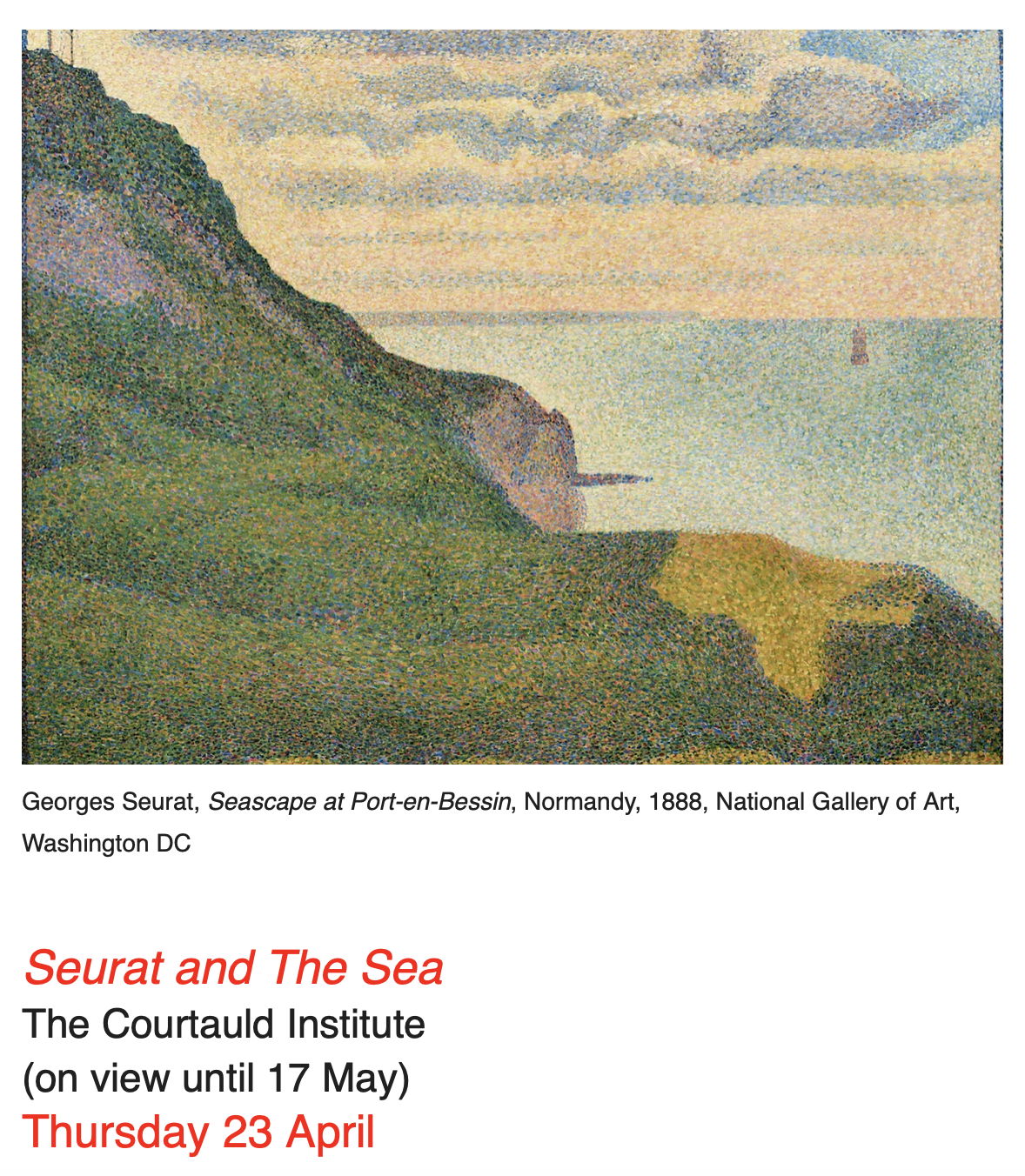
Though Seurat is best-known for his studies of life in his Paris studio in the Parisian suburbs of Asnières and La Grande Jatte, every summer – between 1885 and 1890 – he took himself off to the Atlantic coast of Normandy to paint seascapes. They form over half of his oeuvre of around 45 major works completed before he died, still young, in 1891 aged 31. If the depiction of figures in dots of colour (designed to meld in the eye) was a challenge for Seurat’s chosen technique how much harder must it have been to paint the sea? Yet his ability to offset the structures of the seaside, whether cliffs, piers, jetties or anchors, against the shimmering movement of the water gave rise to some of his most impressive works. It’s as if it was here that his extraordinary technique found its true home. He had the rare ability, unmatched elsewhere in Western art, to capture the kaleidoscopic reflective light of the sea.
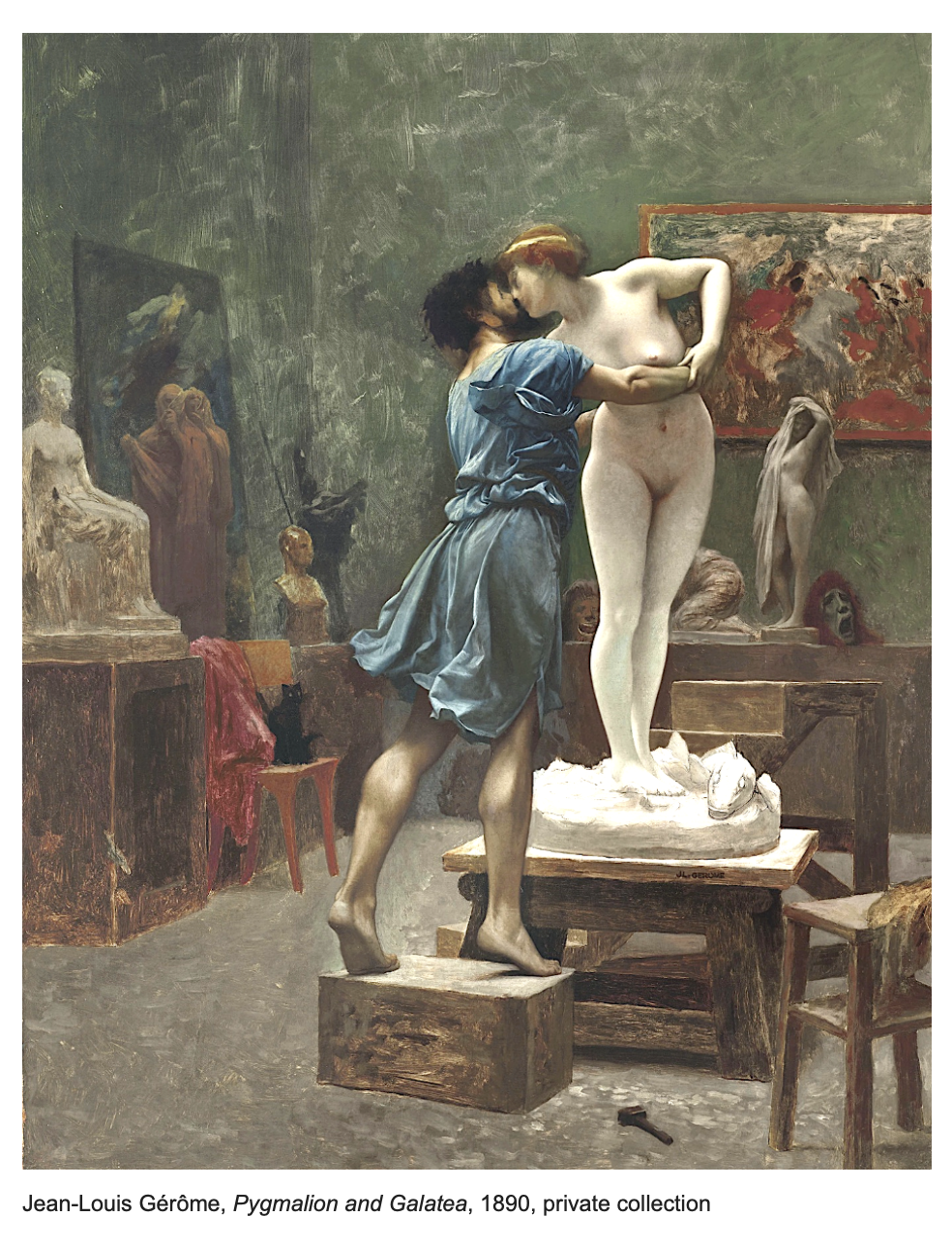
‘All things change, but nothing dies.’ This wonderfully uplifting idea lies at the heart of Ovid’s Metamorphoses, written around 8 AD. He believes, however, that humans, animals and gods constantly change shape: from Arachne, the weaver turned into a spider, to Jupiter, who disguises himself as a bull, a swan or a shower of gold to deceive his jealous wife and his lovers. In 1604, the Dutch painter and writer Karel van Mander famously called the Metamorphoses a ‘Bible for artists‘.
The richness and variety of works inspired by Ovid shows just how true that still is today. Ranging widely from Caravaggio to Bernini, Rodin to Brancusi, Magritte to Bourgeois, we dive into Ovid’s two-thousand-year-old poem and the paintings it inspired. Vengeful gods, ingenious heroes and high-minded mortals, passion, desire, lust, jealousy, cunning and deceit await us!
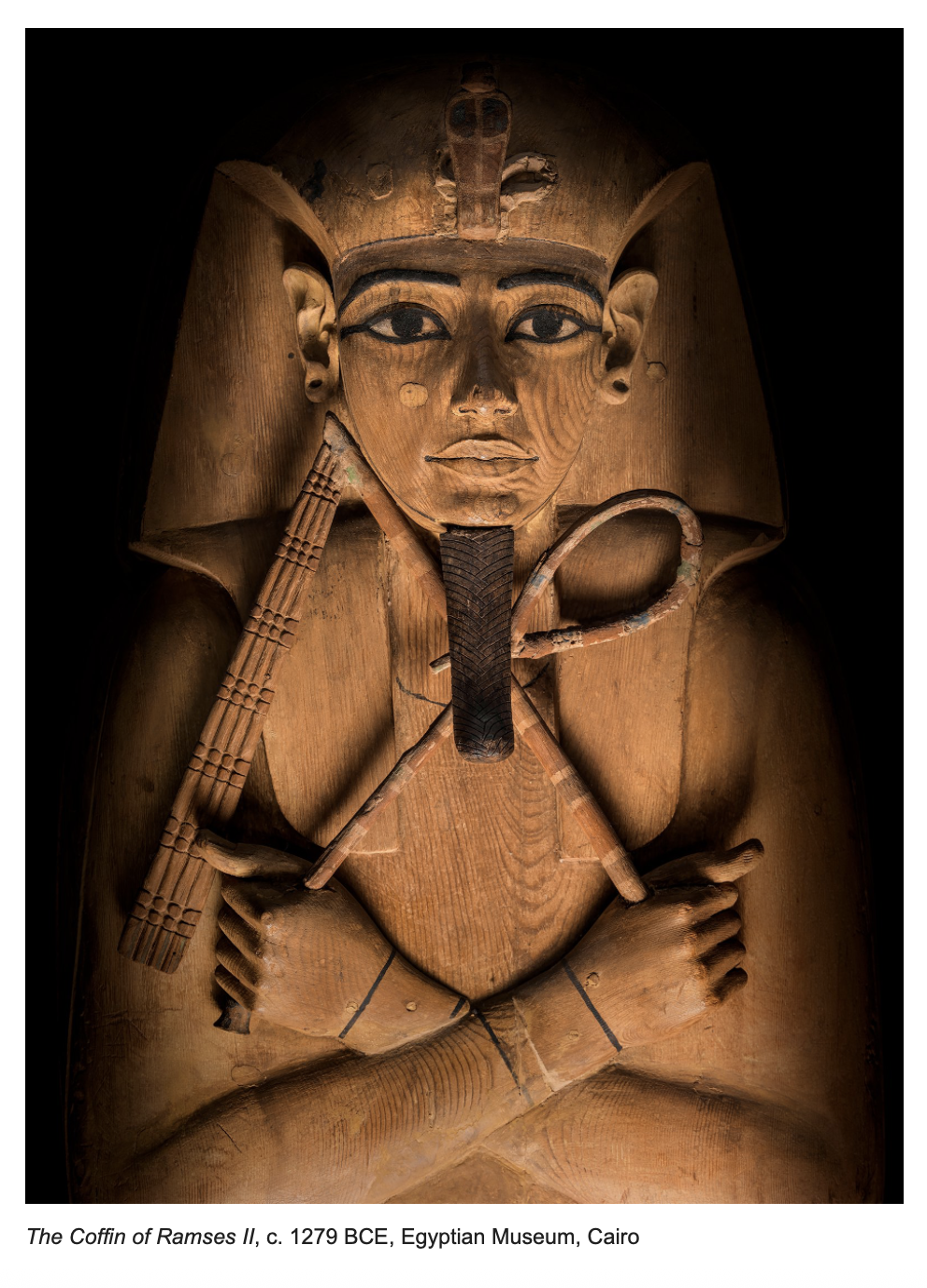
Far more influential than the boy king Tutankhamun, though far less mythologised, King Ramses II, c. 1303 BC – 1213 BC widely known as Ramses the Great, ruled Egypt for nearly 67 years. 3,000 years later, he remains one of history’s most iconic pharaohs. Known for his extensive monument-building, military strategy and diplomacy, and a vast dynasty of more than 100 children, Ramses II sought not only to command an empire, but to secure his immortality for millennia to come. He did this through the commissioning of vast monuments to himself, and precious objects reflecting the eternal brilliance of gold, as have many tyrants both past and present. For his remarkable wooden coffin lid, illustrated above, Ramses II added the pharoah’s twin sceptres of crook and whip, the one to catch, the other to scourge. He must have been a formidable man.
NB We follow this Zoom format lecture with a Face-to-Face gallery visit to the exhibition itself on Friday 27 May, details to follow.
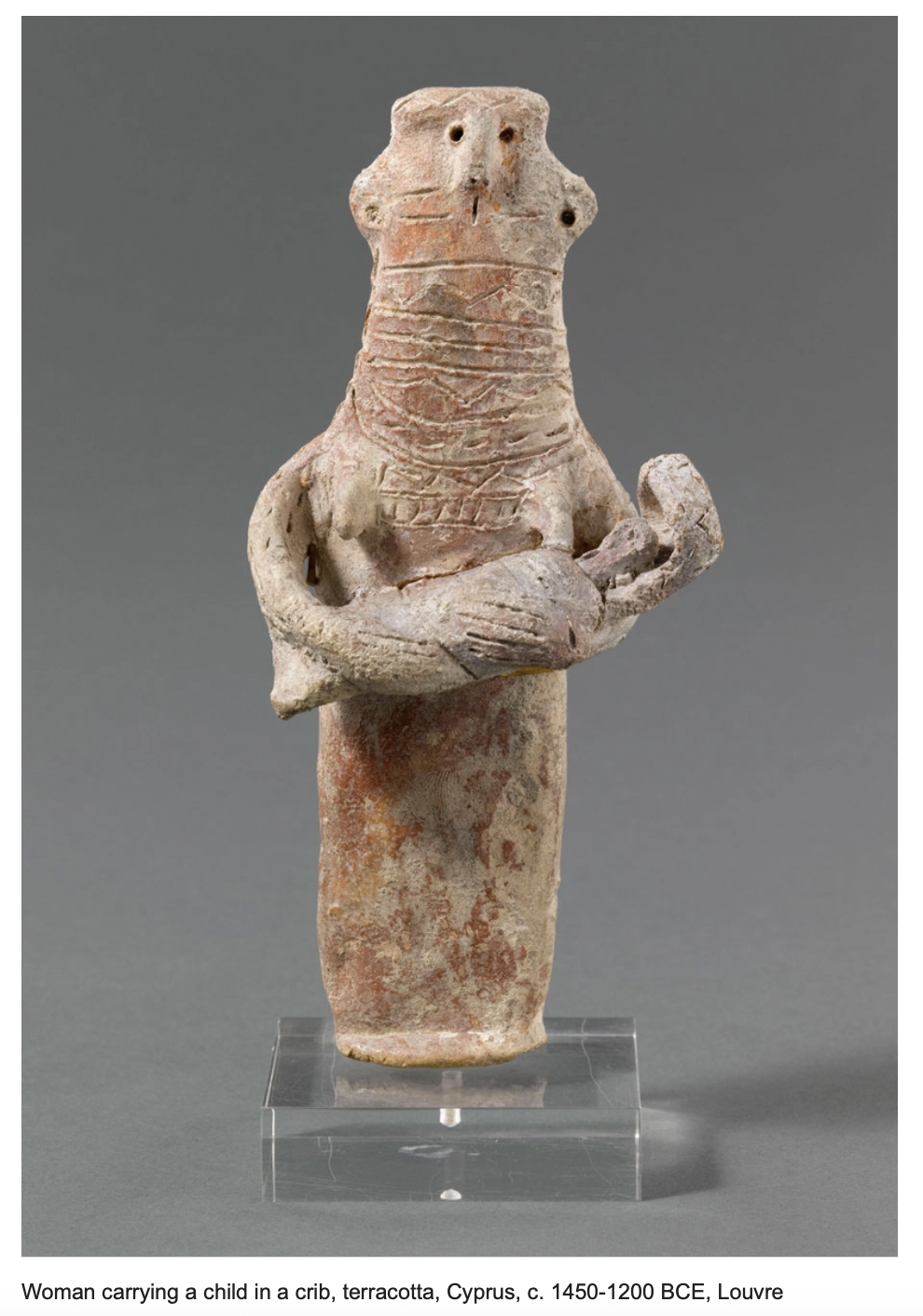

On a map, the island of Cyprus lies poised between West and East: due south of the Taurus Mountains of Turkey, situated so it appears to point a finger at Syria from its east coast. Cyprus was dominant in the eastern Mediterranean for millennnia. Over the course of thousands of years its cultural history has accumulated rich and highly visible influences from the Greeks, the Turkish and the British primarily With a wave of Greek settlement after the collapse of the Myceanean Empire around 1000BCE. Cyprus was seen as the birthplace of the beautiful Greek divinities, none other than Aphrodite and Adonis. Works of art proliferated, some of the best of which are on show in this exhibition, in which key works from the Louvre are augmented with major items from the Cyprus Archaeological Museum.
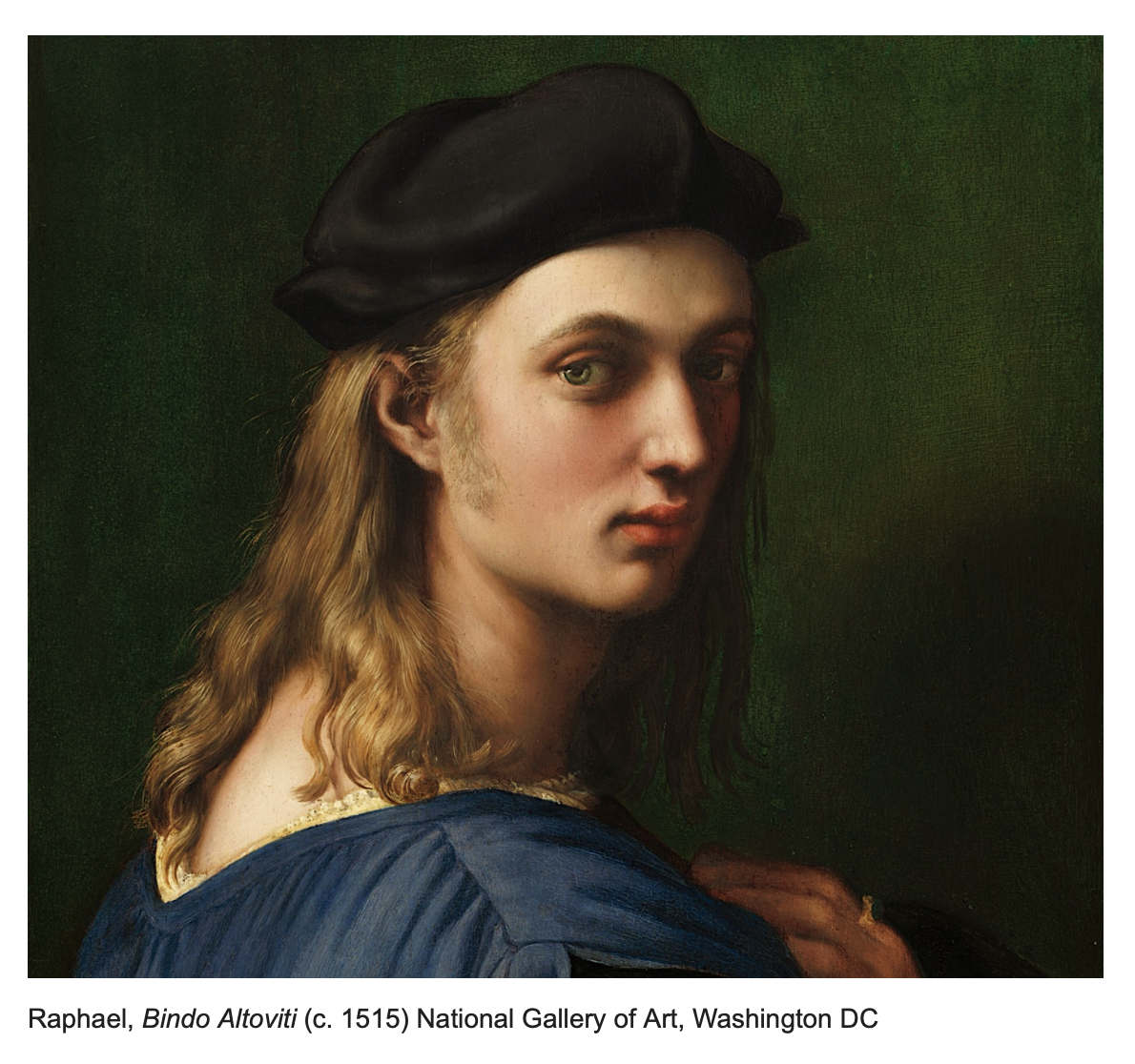
Raphael matched ambition with lyricism to create works with both intellectual heft and emotional depth – a necessary skill in the complex political landscape of Renaissance courts. The son of a painter and poet, Raphael engaged with the foremost writers and thinkers of his age in Rome, displaying a poetic sensibility that captivated his peers and generations that followed. In his short life of only 37 years, he achieved such profound success as a painter, designer, and architect that he was regarded as the pinnacle of artistic perfection for centuries after his death.
Raphael: Sublime Poetry is the first comprehensive exhibition on Raphael in the United States, bringing together more than 200 of the artist’s greatest drawings, paintings, and tapestries from public and private collections across Europe and the United States to trace the full breadth of his life and career, from his origins in Urbino to his rise in Florence, where he began to emerge as a peer of Leonardo da Vinci and Michelangelo, to his final, prolific decade at the papal court in Rome.
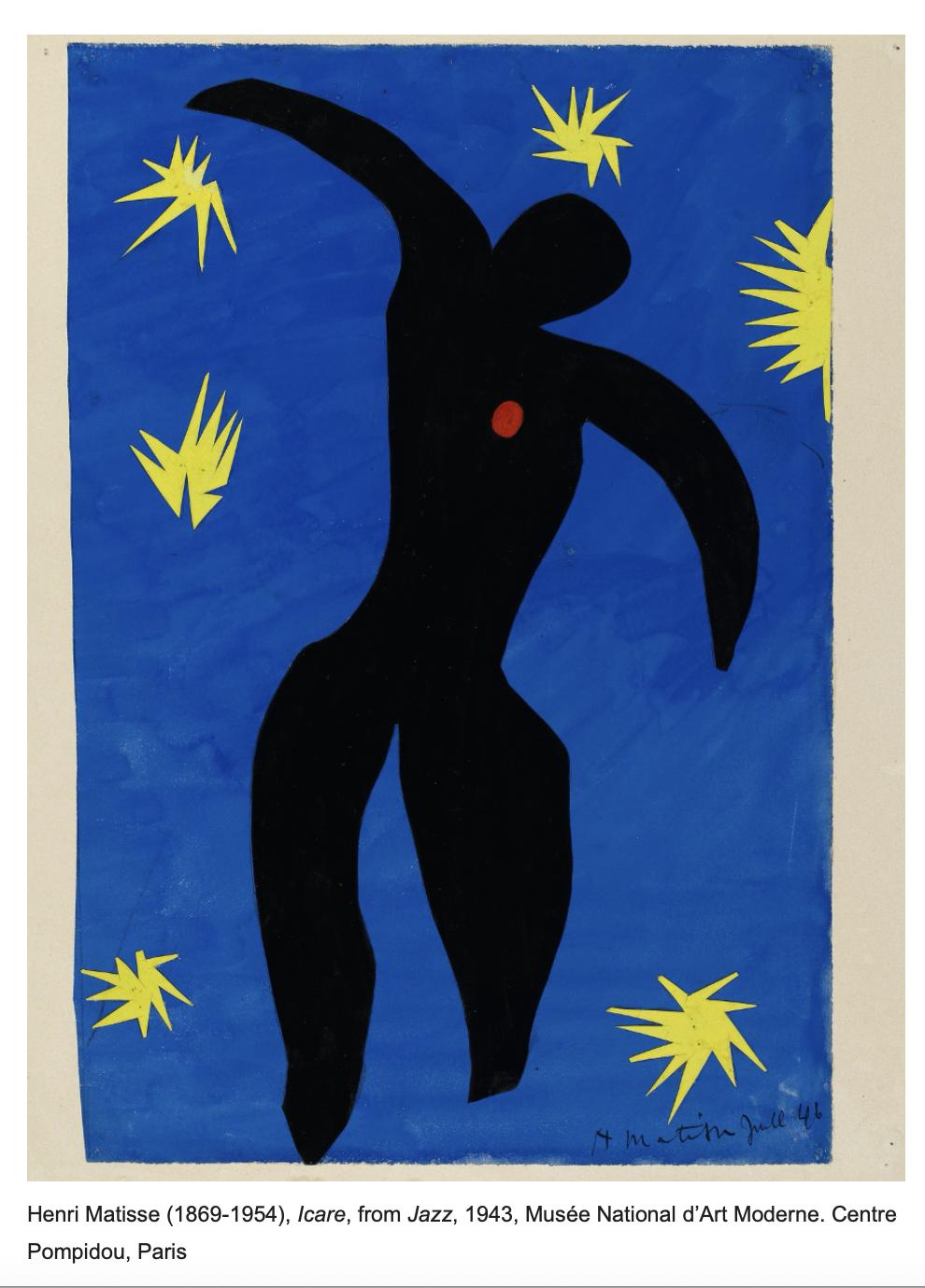
In the inspiring light of his final years when he was bound to a wheelchair and found brushes too difficult to hold, Matisse invented a new medium of expression, one using scissors and painted paper. In spite of handicaps to which most mortals would succumb, he forged on, undeterred, and succeeded in elevating hand cut paper to an art-altering visual art technique; one more than capable, in his hands, of expressing an infinite aesthetic through the supreme skill and simplicity of its execution.
The exhibition shows how painting, far from being supplanted by cut-outs, remains at the heart of his approach. The works unfold with great spatial ingenuity, and intensity of colour. Among the major ensembles gathered here are the majestic and final Intérieurs de Vence series from 1947-1948, the album Jazz, the series of Thèmes et Variationsas well as the brush-and-ink drawings; the main elements of the Chapelle de Vence program; the monumental panels of La Gerbe et des Acanthes, and as a crowning moment, brought together exceptionally, the great cut-out figures: La Tristesse du Roi, Zulma, La Danseuse Créole and the famous Nus bleus. This is not to be missed even if you tire of their frequent appearances on greeting cards!
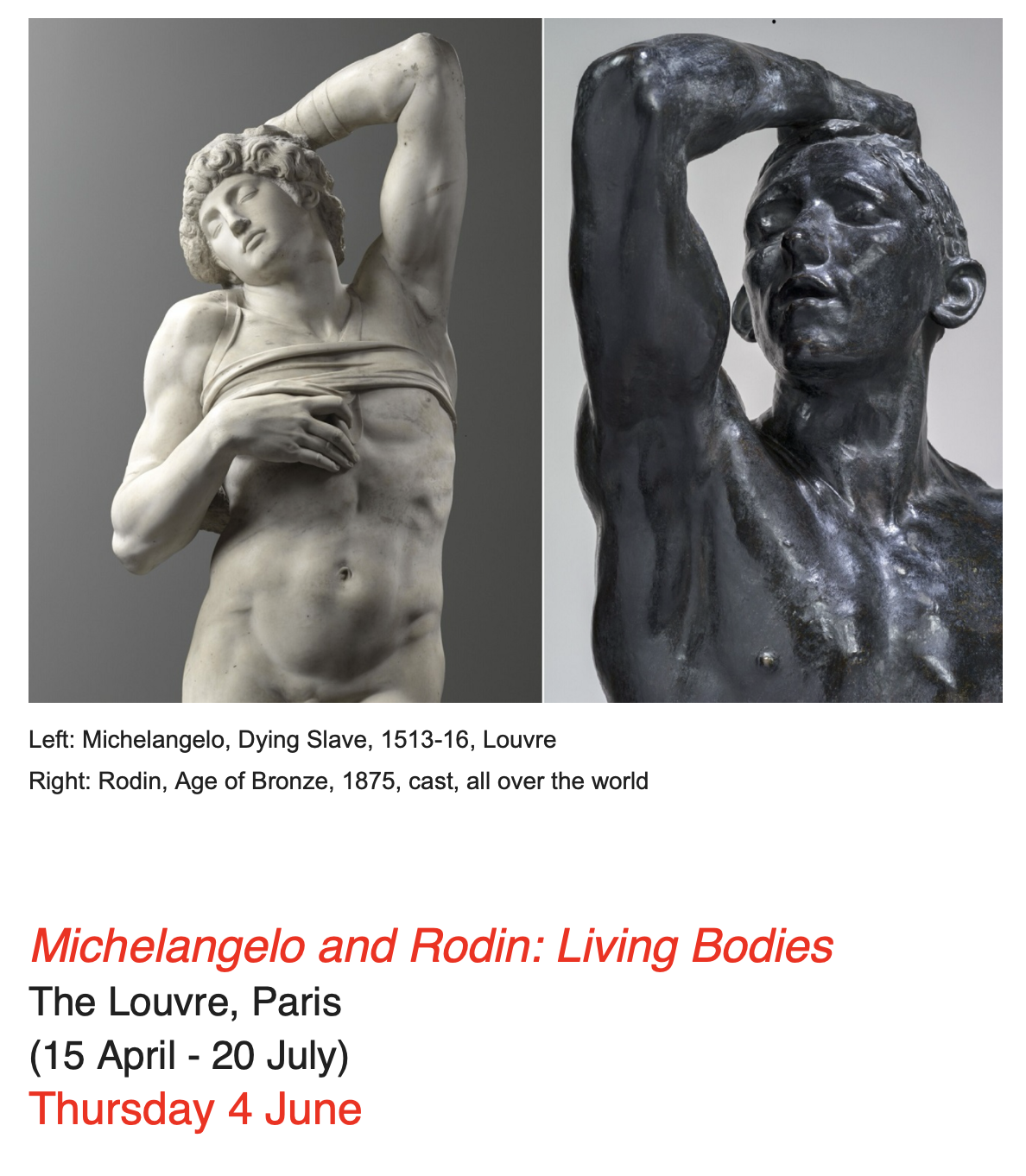
Michelangelo and Rodin, in making the human body the central subject of their artworks, showed that they both perceived it as animated by an intense, silent, inner life. The body is revealed in their work as a special membrane that envelops the soul, a living thing that transcends time and movement. In this exhibition two unrivalled masters of Western sculpture engage in a dialogue across the centuries, calling attention to their connections, borrowings and reinterpretations, enabling a close reading of the myths surrounding them. We will read critical excerpts from Rodin’s ART, a book published from interviews by Paul Gsell in 1912, in which he refers specifically to Michelangelo’s drawings and his great sculptures of the ‘Pietà’ and ‘The Captive’. When Rodin remarks to Paul Gsell ‘Art is the most sublime mission of man, since it is the expression of thought seeking to understand the world and to make it understood,’ perhaps it was Michelangelo, as well as himself, he had in mind.
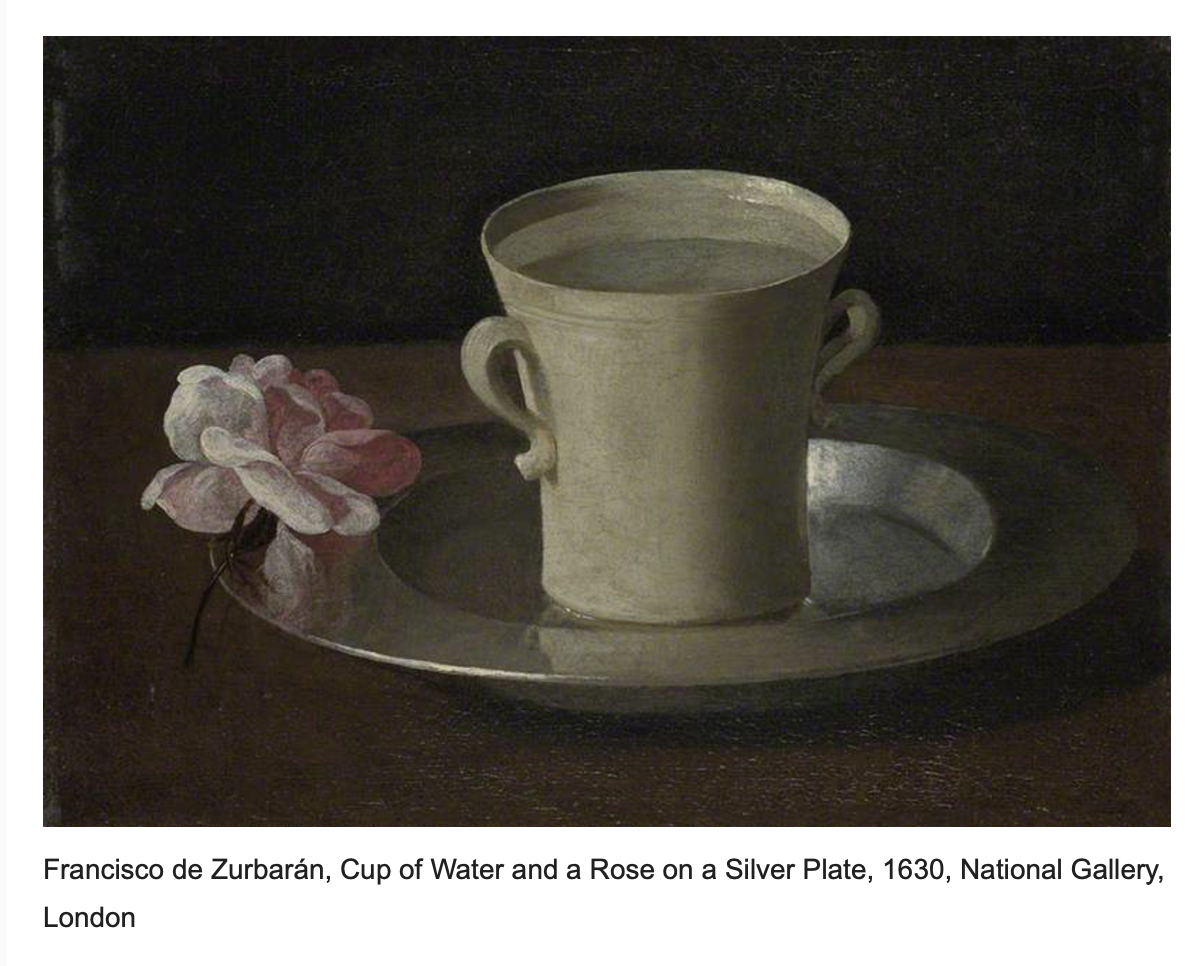
A giant in the history of Spanish art, Francisco de Zurbarán was one of the great painters of 17th-century Seville, a centre of global trade. His vivid paintings – from small serene still lifes to soaring altarpieces- all burst with life, his vision of the real object whether flower or polished silver is loving, affectionate and conveys intense spiritual experience. His religious devotion stirs even the most hard-hearted atheist, as he takes us into the minds and meditations of Franciscans, their heads lost in the deep shadows of their cowls. Renowned as a painter of fabrics, Zurbarán represented extravagant clothing as well as the austere robes of those in orders, with unsurpassed skill.
He was also a careful observer of lived reality. Ordinary items – a ceramic vessel, a wicker basket, a rose – bring his extraordinary subjects not only closer to everyday life, then and now, but aim to remind us of the sheer beauty in the ordinary. The first ever devoted to the artist in the UK, this exhibition brings some of his greatest paintings to London from all over the world.
Information:::::::::::::::::::::::::::::::::::::::::::::::::::::::::::::::::::::::::::
EXHIBITIONS Spring 2026 ‘ is a Zoom course (for which we offer support to access) which has been developed, designed and edited by Louise Friend and will be presented by Nicholas Friend. It is held on Thursdays, beginning on Thursday 9 April until Thursday 11 June 2026 at 5pm.
If you book for the course but cannot manage a particular date, then be assured we will be sending recordings of sessions to all registered participants. Each session meets from 15 minutes before the advertised time of the lecture, and each lasts roughly one hour with 15 minutes discussion.
COST:
£500 for members, £600 non-members for ten sessions.
All sessions are limited to 21 participants to permit a vibrant after-lecture discussion session.
Please make your payment to Friend&Friend Ltd by bank transfer to our account with Metrobank, bank sort code 23-05-80, account number 13291721 or via PayPal to nicholas@inscapetours.co.uk, or credit/debit card by phone to Henrietta on 07940 719 397 who is available on Tuesdays or Thursdays between 2-5 pm.
How to Set Up a PayPal account::::::::::::::::::::::::::::::::::::::::::::::::::::::::::::::
Click on this link: https://www.paypal.com/uk/home
In the upper right-hand corner of the screen, click “Sign up.”
On the following screen choose “Personal account” and click “Next.”
On the next page, you’ll be asked to enter your name, email address and to create and confirm a password. When finished, click “Next.”
Click “Agree and create account” and your PayPal account will be created.
How to Connect your Bank Account to your PayPal account:::::::::::::::::::::::
Log on to your account and click the “Wallet” option in the menu bar running along the top of the screen.
On the menu running down the left side of the screen, click the “Link a credit or debit card”.
Enter the card information you wish to link to your PayPal account and click “Link card” for debit card.
How to Send Money::::::::::::::::::::::::::::::::::::::::::::::::::::::::::::::::::::::::::::::::
Log on to your account. Click Send & Request.
Enter the email address of the person you wish to send money to: nicholas@inscapetours.co.uk
Type in the amount you wish to send, click continue then press ‘Send Money Now’.
 INSCAPE CULTURAL STUDY SOCIETY