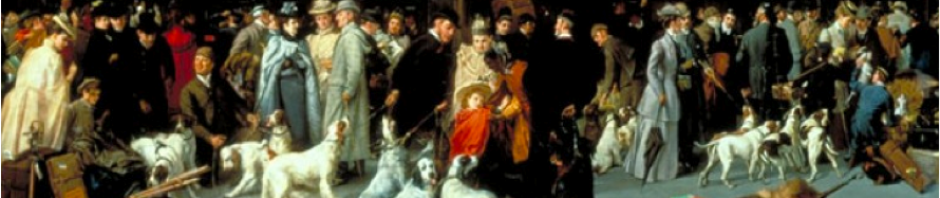

Impatient with in-studio costumed history paintings and stuffed-shirt portraits of the establishment elite, artists since the 19c have sought to discover more authentic subjects and more inspiring locations for their work. Many retreated to the ever-varying nature of the countryside or the coast in pursuit of stimulation that could not be found within the four walls of their studios. By the 1840s the exodus of artists from metropolitan areas was in concert with nascent social and political concerns for the lives of rural and coastal working communities. Though some artists still saw their human subjects as ‘picturesque’ objects at work in the fields or toiling on the beaches, still others saw with compassion the unremitting harshness of lives spent marginalised by poverty, and at the mercy of nature’s caprice. Many artists, unless living off money from the dead, were also amongst the untouchables in the economic and social ‘caste’ system in their respective countries.
Drawn by many factors including a lower cost of living, the promise and pleasure of small village life, and the company of peers, many attendees enjoyed added benefits. In addition to providing artists with time, space, and support to work, some communities provided lectures, workshops, and even exercise classes. Retreating to local inns at the end of day’s painting session the artists could enjoy one another’s company, eat and drink well, and amiably comment on one another’s work. Unfortunately for the innkeeper, the bill for a pleasant evening repast by a table of merry artists might need be paid in paintings rather than in cash!
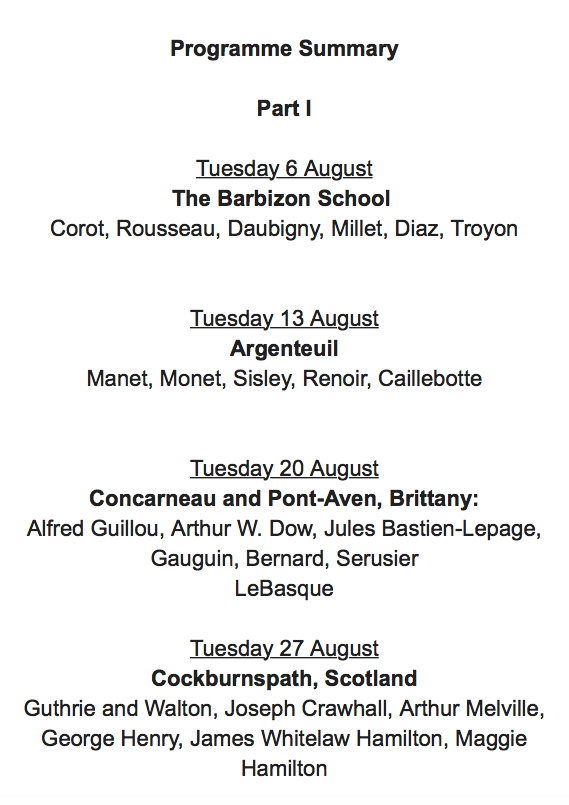
Art colonies initially emerged as village movements in the 19th and early 20th century. Between 1830 and 1914, some 3,000 professional artists participated in a mass migration from urban centres into the countryside, residing for varying lengths of time in over 80 communities. Transient colonies had annually fluctuating populations of artists, often painters who visited for just a single summer season, in places, such as Honfleur, Giverny, Katwijk, Frauenchiemsee, Volendam, and Willingshausen. Semi-stable colonies characterized by their semi-permanent mix of visiting and resident artists included Ahrenshoop, Barbizon, Concarneau, Dachau,St. Ives, Laren, and Skagen. Stable colonies characterized by large groups of permanent full-time resident artists who bought or built their own homes and studios, flourished in places such as Egmond, Sint-Martens-Latem, Newlyn, St Ives, and Worpswede.
Some painters settled permanently in a single village, most notably Jean-François Millet at Barbizon, Robert Wylie at Pont-Aven, Otto Modersohn and Otto Modersohn and Paula Becker at Worpswede, Heinrich Otto at Willinghausen, and Claude Monet at Giverny. There were also regular ‘colony hoppers’ who moved about the art colonies of Europe in a nomadic fashion. Max Liebermann, painted at Barbizon, Dachau, Etzenhausen and at least six short-lived Dutch colonies; Frederick Judd Waugh worked in Barbizon, Concarneau, Grèz-sur-Loing, St Ives and Provincetown in the United States; Evert Pieters was active at Barbizon, Egmond, Katwijk, Laren, Blaricum,Volendam,and Oosterbeek; Elizabeth Forbes painted at Pont-Aven, Zandvoort, Newlyn and St Ives. The painter Annie Goater wrote of her recent experiences at one French colony, “Russia, Sweden, England, Austria, Germany, France, Australia and the United States were represented at our table, all as one large family, and striving towards the same goal.”
While artist colonies appeared across Europe, as well as in America and Australia, the majority of colonies were clustered in Britain, France (encircling Paris), Central Germany and the Netherlands. Artists of thirty-five different nationalities were represented throughout these colonies, with Americans, British, and Germans forming the largest participating groups.
Needless to say, the outbreak of World War I in Europe shattered most communities of creative individuals seeking recognition through friendship and fellowship, empowerment from audiences of their peers, and the comfort of the true colours in all aspects of nature: from the dramatic palette of the skies and seas to the subtle everchanging palette of the landscape. What remains for us to study is their lives and the glorious fruits of their endeavours.
Please join us as we retreat with these artists from their grey-tone polluted cities to the big skies and salty air of the west coast of England, or to the dappled dancing light of fields, valleys and dales covered with all manner of trees and crops and errant flowering weeds. We truly look forward to making this summer and early autumn armchair journey with you!
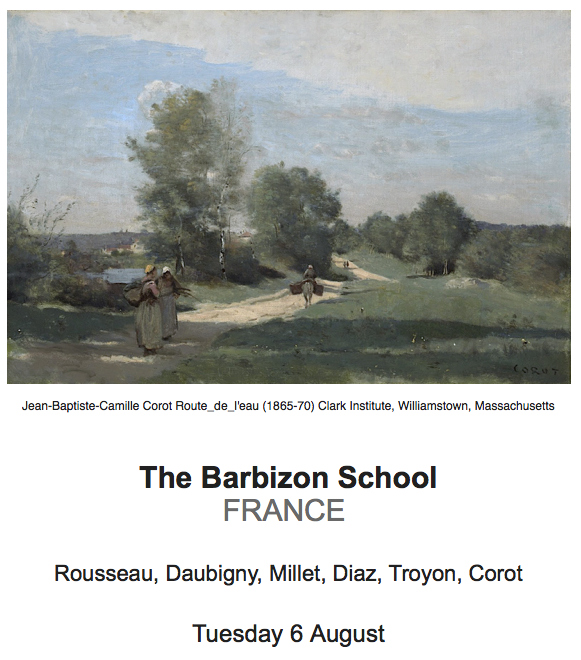
The first notable art colony was in the Forest of Fontainebleau near the village of Barbizon. Here painters such as Jean-Baptise-Camille Corot, Theodore Rousseau, Charles Daubigny, Jean-Francois Millet found the richness of experience they sought. Not for nothing have they been referred to as the Barbizon School for what they established was a kind of outdoor art school where their teachers would be none other than the natural world!
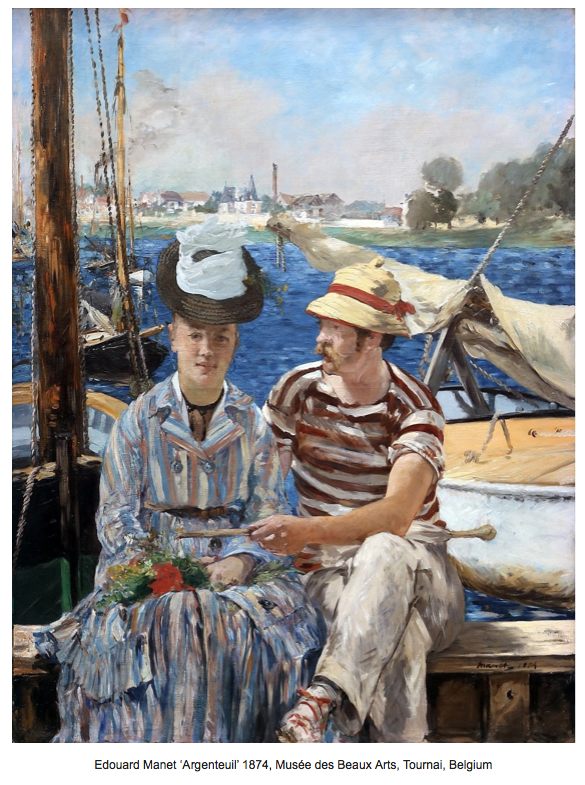
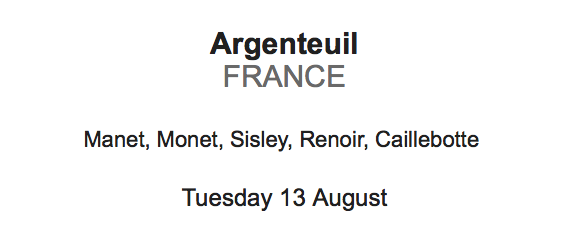
The individuals of the Barbizon School were followed to Fontainebleau by the young Monet and Renoir, who in turn set up their own mutually supportive group of painters, including Manet and Caillebotte, at Argenteuil, 12 km from the centre of Paris. With its dazzling reflections of light off the River Seine and the animated scene afforded by boats and river swimmers, Argenteuil was an unsurprising and brilliant choice.
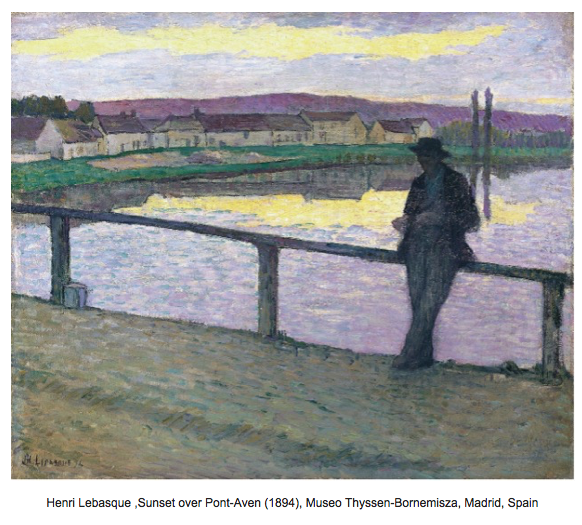
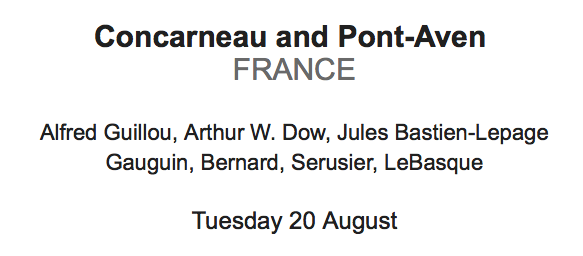
Gauguin found himself leader of the Pont-Aven group of artists, including Bernard, Serusier and Lebasque. There he could feel something true, something literally grounded, when he heard the ring of his clogs on solid earth rather than pavement. He painted the radical ‘Vision After the Sermon’ at Pont-Aven, and Serusier painted what is the first almost-abstract landscape there. But Pont-Aven was a small village, and some artists, like Cecilia Beaux, Arthur Dow and Jules Bastien-Lepage moved to the nearby large town of Concarneau, where they could discover other riches for their brush.
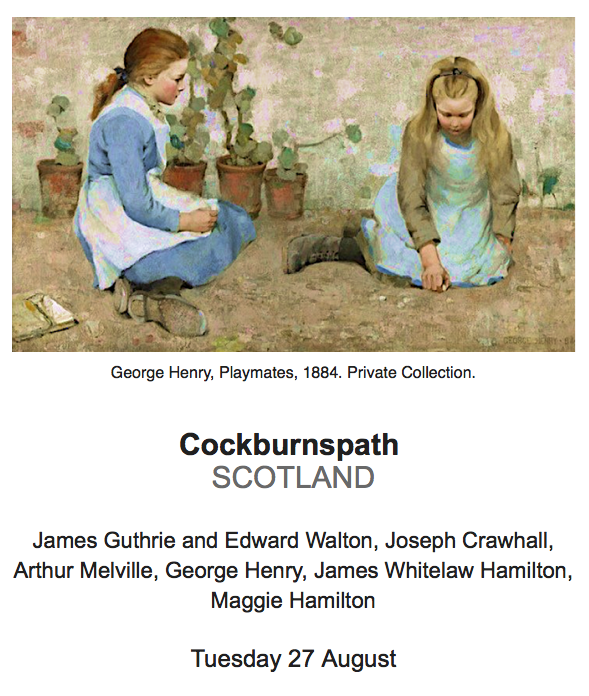
Searching for new painting locations in 1883, the radical, thoroughly un-English, Glasgow School painters, notably James Guthrie and Edward Walton, took lodgings in Cockburnspath, a village on Scotland’s south-east coast, midway between Edinburgh and the English border. Over the following three years, Guthrie and Walton, still in their early twenties, welcomed denizens of Glasgow’s enthusiastic new painting community, including their mutual friend the Northumberland-born artist Joseph Crawhall, Arthur Melville, George Henry, James Whitelaw Hamilton, and ‘Glasgow Girl’ Maggie Hamilton.
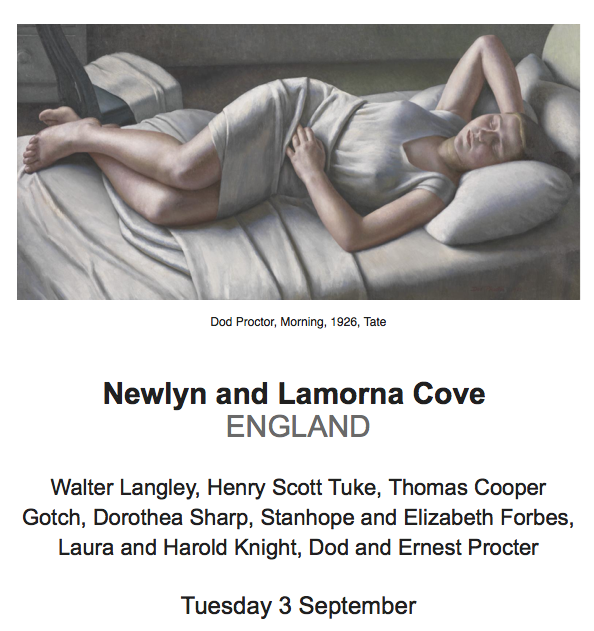
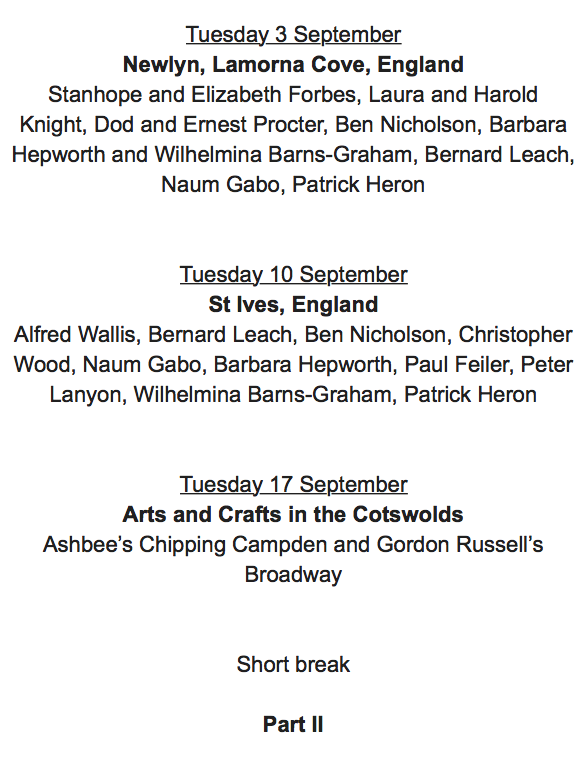
Cornwall was (and still is) the location for two astonishingly long-lived art colonies, in Newlyn and nearby Lamorna Cove, and St Ives. Newlyn, a fishing village adjacent to Penzance on the south coast of Cornwall, attracted English artists who found there scintillating light, cheap living, and inexpensive models. Walter Langley and Stanhope and Elizabeth Forbes Forbes were its earliest pioneers. The latter founded a school promoting figure painting. Lamorna, a fishing village to the south, became popular with artists of the Newlyn School, SJ “Lamorna” Birch who later became an Royal Academician painted in oil and watercolour. Birch, Tuke, and Gotch exhibited together. The catalogue said, “These painters helped to change the face of British art. Their emphasis on colour and light, truth and social realism brought about a revolution in British art.” Dod Procter, extremely talented wife of fellow artist Ernest Proctor, began studying art at age 15; she studied with Stanhope Forbes at the School. There she met Laura Knight who became a lifelong friend and necessary ally.
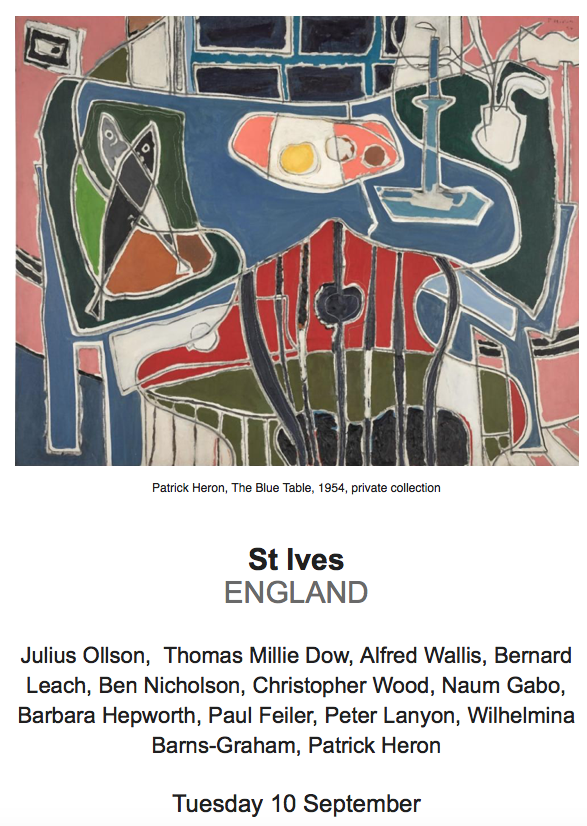
J M W Turner made his way to St Ives twice, once in 1811, and again in 1813. James McNeill Whistler and his student Walter Sickert arrived in St Ives via the 1877 Great Western Railway’ extension to west Cornwall, which was to be used by successive generations thereafter: Julius Olsson became an inspiring and insufficiently well-known sea painter there in the 1880s. The potter Bernard Leach came to join Francis Horne’s art colony in 1920, and in 1928 Ben Nicholson and Christopher Wood came down and met the indigenous Cornish painter Alfred Wallis. At the outbreak of war in 1940 they established themselves there along with Naum Gabo and Barbara Hepworth. Their presence gave rise to a remarkable school of post-war British art, which included such radical figures as Peter Lanyon and Wilhelmina Barns-Graham, painting swirling crystalline Cornish light, as well as the coloured abstracts of Patrick Heron, and inspired by his cliffside garden and association with Mark Rothko.
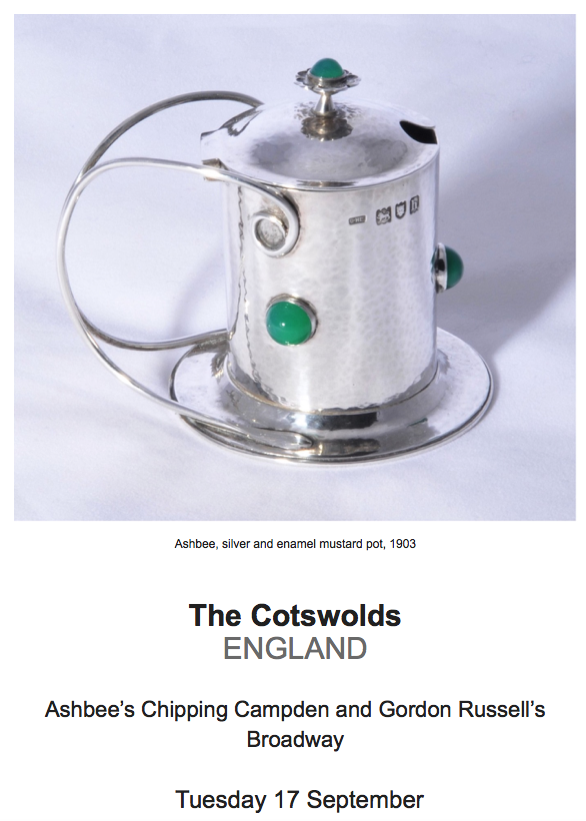
In 1888, the architect Charles Robert Ashbee achieved the remarkable feat of establishing the Guild of Handicraft in the East End of London with absolute and well-founded faith in Eastenders artistic ability. In 1902 he achieved the equally remarkable feat of uprooting 120 Guildsmen and their families and transplanting them to the Cotswolds, where they were the subject of astonishment. Not long after, and influenced by Ashbee, Gordon Russell cut his teeth designing furniture for his father’s Hotel the Lygon Arms in nearby Broadway, inspiring others there, before going on to become Director of the Design Council.
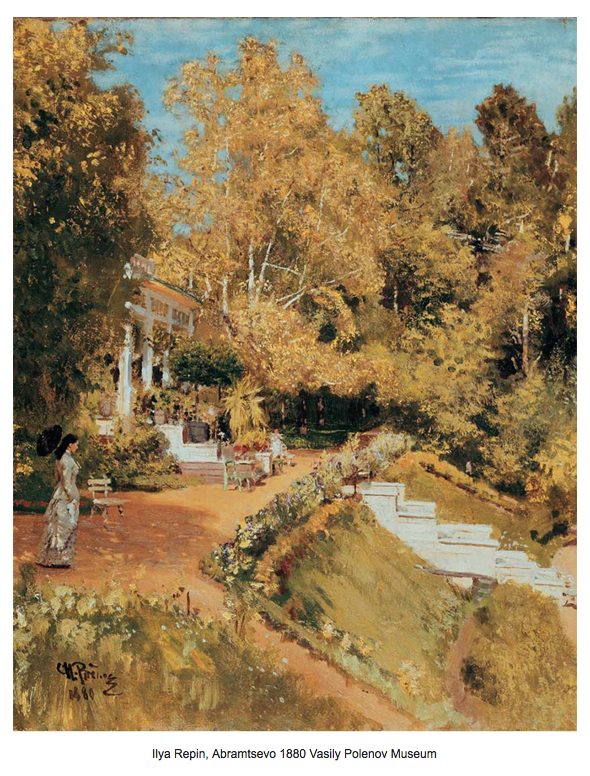
Abramtsevo, a former country estate north of Moscow, became a centre for the Slavophile movement and an artist’s colony in the late 19c. During the 1870’s and 1880’s the estate hosted a colony of artists who sought to recapture the quality and spirit of medieval Russian art in a manner parallel to the Arts and Crafts movement in Britain. Workshops were set up to produce handmade furniture, ceramic tiles, and silks imbued with Russian imagery, and so contributing to late 19c Russian nationalism. Towards the turn of the 20c drama and opera on Russian folklore themes were produced there by Stanislavsky with sets by Vasnetsov, Mikail Vrubel and others.
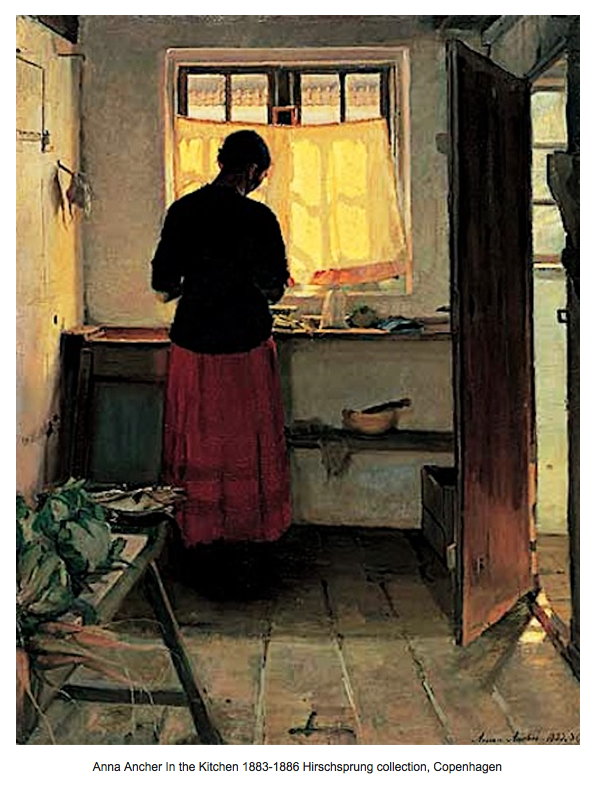
A plethora of superlative northern European artists, from Norway’s Christian Krohg to Denmark’s luminists P S Kroyer and Anna Ancher gathered every summer at Skagen, on the north Danish coast, to paint and enjoy one another’s friendship. Rich relationships were formed, and sometimes broken.
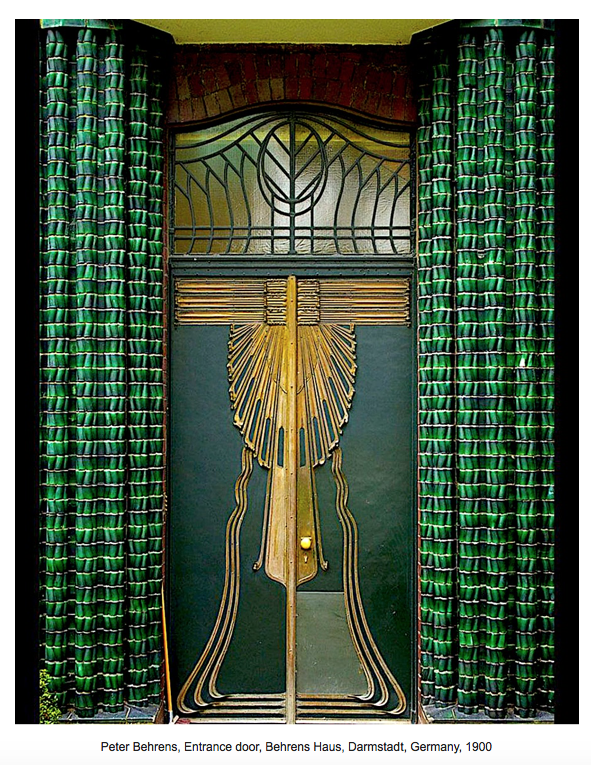
An extraordinary art colony, producing architecture, painting, furniture and ceramics, was established in Darmstadt near Frankfurt by Ernst Ludwig, Grand Duke of Hesse in the late 19c and early 20c. His motto was “My Hessian land shall flourish and in it the arts”. The Jugenstil artists’ goal was to be the development of forward-looking studios, residential and other architecture, landscape design, and interior design. It is now a World Heritage Site.
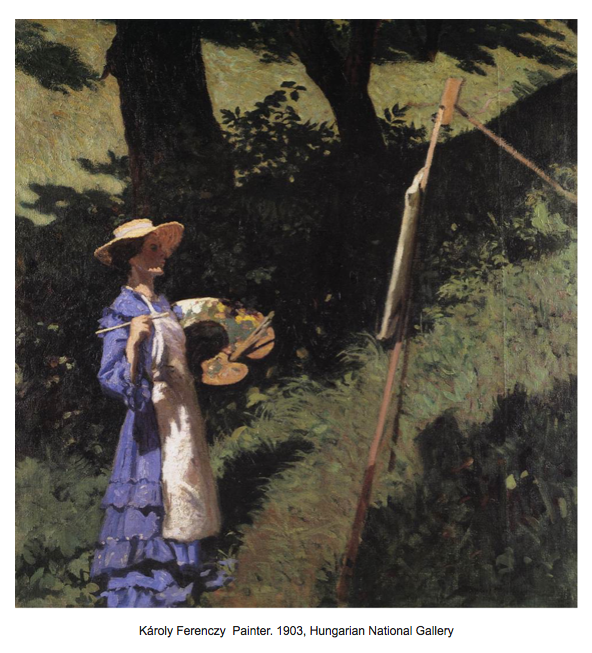
In Hungary, whose contributions are too often ignored, fluid Art Nouveau works were produced in stained glass and furniture at Godollo by Aladar Korosfoi-Kriesch, Sandor Nagy and Miksa Roth. In the foothills of the mountains of Transylvania at Nagybanya, paintings by Karoly Ferenczy and Noemi Ferenczy are often prescient of more modernist concerns with few details set in startling contrasts of light, shade and colour.
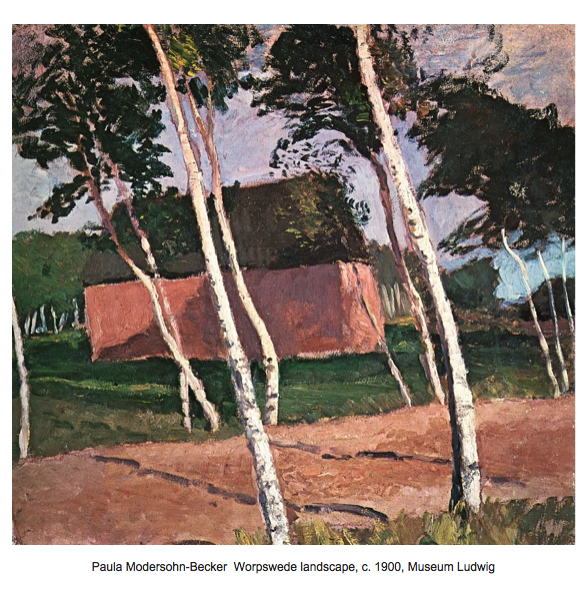
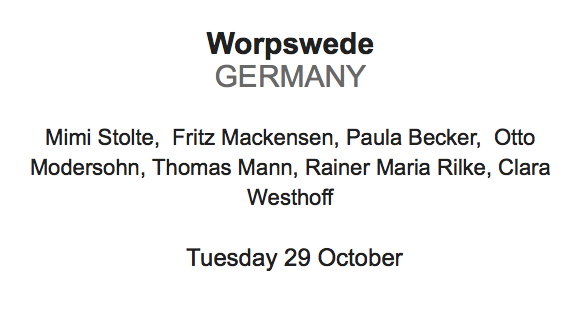
The quintessential German art colony, Worpswede, in Lower Saxony originally attracted the likes of the adventurous avant-garde painter Paula Becker and her husband Otto Modersohn, along with Heinrich Vogeler. Settling in north Germany near Bremen, the artist painted the local landscape in a romantic style with peasants at work in the heaths, meadows, and forests with details like windmills and bridges. The poet Rainier Maria Rilke accompanied his wife the sculptor Clara Westhoff, and published, ‘Worpswede’, about the artists and the landscape.


Booking Information:::::::::::::::::::::::::::::::::::::::::::::::::::::::::::::::::::::::::::
This online course via Zoom has been developed by Louise Friend. It will be presented by Nicholas Friend. It is held on Tuesdays, beginning on Tuesday 6 August 2024 at 5 pm and ending on Tuesday 29 October 2024 at 5 pm. Please note the time of 5 pm: Nicholas will be lecturing from California (at 9 am his time) for the duration of this course.
You may choose to attend individual sessions or all ten. If you book for the course but cannot manage a particular date, then be assured we will be sending recordings of sessions to all registered participants. Each session meets from 15 minutes before the advertised time of the lecture, and each lasts roughly one hour with 15 minutes discussion.
COST: £48 per session, £576 for all twelve for members, £58 and £696 for all twelve for non-members. All sessions are limited to 21 participants to permit an after-lecture discussion session.
Please make your payment to Friend&Friend Ltd by bank transfer to our account with Metrobank, bank sort code 23-05-80, account number 13291721 or via PayPal to nicholas@inscapetours.co.uk, or credit/debit card by phone to Henrietta on 07940 719 397. She is available Tuesdays 10-12 and 2-5 pm or Thursdays 10-12 and 2-5 pm.
How to Set Up a PayPal account::::::::::::::::::::::::::::::::::::::::::::::::::::::::::::::
Click on this link: https://www.paypal.com/uk/home
In the upper right-hand corner of the screen, click “Sign up.”
On the following screen choose “Personal account” and click “Next.”
On the next page, you’ll be asked to enter your name, email address and to create and confirm a password. When finished, click “Next.”
Click “Agree and create account” and your PayPal account will be created.
How to Connect your Bank Account to your PayPal account:::::::::::::::::::::::
Log on to your account and click the “Wallet” option in the menu bar running along the top of the screen.
On the menu running down the left side of the screen, click the “Link a credit or debit card”.
Enter the card information you wish to link to your PayPal account and click “Link card” for debit card.
How to Send Money::::::::::::::::::::::::::::::::::::::::::::::::::::::::::::::::::::::::::::::::
Log on to your account. Click Send & Request.
Enter the email address of the person you wish to send money to: nicholas@inscapetours.co.uk
Type in the amount you wish to send, click continue then press ‘Send Money Now’.
 INSCAPE CULTURAL STUDY SOCIETY