

Christmas has become an international festival celebrated ’round the globe in both Christian and non – Christian countries alike. The early church fathers had no idea what they started when they spread the word of that particular baby born in a humble stable 2,024 years ago. Historically, the Christmas festival had little significance when compared with the real heart and soul of Christianity, the Easter Resurrection. Christmas came a poor second in the liturgical calendar. Yet, building on the ancient Roman feasts of Saturnalia, Christmas began its evolution in the early Middle Ages following a circuitous trajectory to our current global festivity.
Christmas, for Christians and many others, with all its contradictions and paradoxes, and despite, or perhaps because of, its secularisation, is a distinctly special festival designed to uplift and drive away gloom. The extravagant trappings of our Anglo-American Christmas are now emulated all over the world from Canada to Japan. Perhaps Christmas is, as one historian has suggested, England’s most significant cultural export. Better to understand his claim we will in this short sweet Christmas course examine the ways our current Christmas paradigm has been addressed in print and film in fairly recent times.
Christmas has evolved as a set of ideas and feelings disseminated in many ways, but for our purpose, we shall focus on transmission by widely read magazines and by film viewed in the shared environment of the cinema. It is to these two stimulating and significant forms of cultural transmission that this Inscape Christmas offering, culminating in a heart-and-body-warming Art Worker’s Guild Inscape Christmas Party, is dedicated.
First, a Zoom Lecture explores developing traditions through the ingenious Christmas covers of two iconic magazines, the Illustrated London News from 1842, and the New Yorker, from 1925. In the former, through engravings by the best artists of the day, we discover a gargantuan plum pudding eaten by a plump bearded figure with bottles in his hair; a family Christmas tree being topped off with, not an Angel, but a Union Jack, and Father Christmas as a druid emerging from a bowl of wassail.
In America, as the messages of Victorian Christmas go viral in the United States, we find good-natured and brilliantly-executed New Yorker covers teasing English traditions with Father Christmas being greeted at the door by a terribly stiff upper-lip butler, or a steward gingerly hanging a Christmas wreath in a club full of sleeping moustachioed patrons avoiding the seasonal upheaval at home, or somnolent parents being woken far too early on Christmas morn by excited children blowing brightly-coloured trumpets. Each cover, whether in London or New York, reveals the concerns and paradoxes of its own time, so that such an exploration becomes an abbreviated history of the past 150 years.
Moving on from printed material, we consider how the medium of film was used for a vast range of investigations into what Christmas may mean and how it may be celebrated. In Britain we see the reinvention of Victorian traditions in numerous iterations of Dickens’ A Christmas Carol”, and film used as propaganda with the Ministry of Information’s ‘Christmas Under Fire’ of 1941 hoping to persuade Americans to join the war, and Christmas seen as a means of resolving modern family tensions, as in ‘The Holly and the Ivy’ of 1952, with Ralph Richardson, Celia Johnson and the brilliantly soulful Margaret Leighton.
Meanwhile, Hollywood studios took an early interest in Christmas movies, ranging from Laurel and Hardy’s ‘Babes in Toyland’ of 1934, ‘Bachelor Mother’ of 1939, to the touching profundity of the iconic film ‘It’s a Wonderful Life’. Here Frank Capra took the theme of the perils of working life several levels deeper with his star, the inimitable James Stewart, who plays a kind man who struggles mightily with his insignificance before being rescued by Christmas, his family, and his fellow citizens in the small town of Bedford Falls.
Cost: £50 members £55 non-members
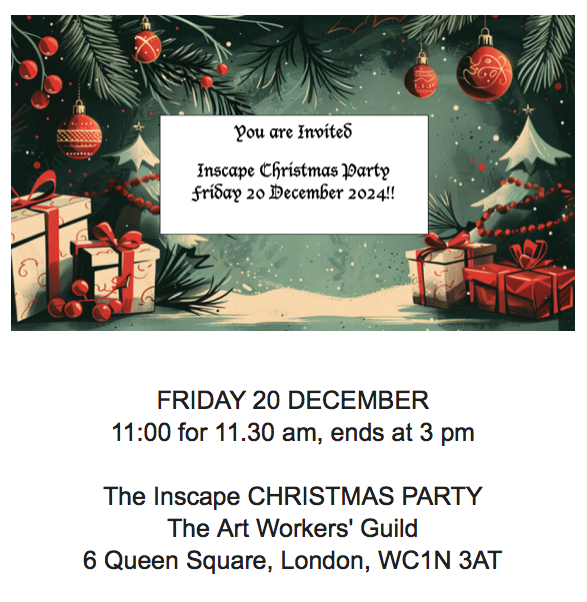
Almost all religions involve a cycle of observances that include a social ‘gathering’, actually the true definition of ‘congregation’. Hence we will congregate at our Christmas Party next month where each of you will be warmly welcomed by Henrietta and Nicholas with our traditional cafetière coffee, first-class biscuits, and chat, before we settle down in our chairs to watch the original 1947 version of the film ‘Miracle on 34th Street’. Although ostensibly about an affable white-bearded man who believes himself to be Santa Claus, its message actually is that Santa Claus is important to our lives, and Christmas a holiday for adults- not just for children. It is crisply directed by George Seaton, teasing in its treatment of the law, and the lead played by Academy – Award – winning Edmund Gwenn with just the right mix of intelligence, kindness and a touch of magic.
After the film we may go on discussing its contents and our own reminiscences of Christmas as we indulge in our variation on Christmas lunch, with the familiar “moreish” sandwiches from Prêt à Manger, including vegetarian options, of course, wine for those who are being driven by tube, bus or taxi driver, mince pies with cream, and mandarins such as you might find in the toe of a Christmas stocking. We can promise you the kind of conversations that take place between old friends or between people who have never met before, but feel they in the right environment for pleasant talk. We do so hope to see you there! Please know that the Art Workers’ Guild and we will do everything possible to accommodate those friends and members with limited mobility.
Cost: £125 members, £135 non-members

Some of you may remember a reading I made of Dickens’ ‘A Christmas Carol’ . That iconic story inspired later generations to regard Christmas as a time for giving in order to experience their own and others’ wellbeing. Dickens himself much admired an earlier Christmas story by Washington Irving, well-known as the writer of ‘The Legend of Sleepy Hollow’ and ‘Rip van Winkle.’ Though America regards him as one of their own, he was the son of an Orkney islander father and a Cornish mother who had settled in Manhattan before his birth in 1783. Born just as news of the American Victory in the War of Independence reached New York, Irving was named for the great General George Washington later to become the first President of the United States.
Irving travelled widely in Europe for 17 years, became secretary to the American Legation in London, and eventually United States Minister to Spain. But his public reputation rests on his beautifully written stories, hugely admired by not only Dickens, but by Byron, Mary Shelley and Walter Scott.
His short pieces on the theme of ‘Old Christmas’ appeared in ‘The Sketch Book of Geoffrey Crayon, Gent’, published serially in 1819 and 1820. Through his ‘nom-de-plume’ of Geoffrey Crayon, Irving imagined Christmas as celebrated in an ‘Old English’ Manor House.
The Stagecoach 14 minutes
Christmas Eve 24 minutes
Christmas Day 28 minutes
Christmas Dinner 27 minutes
We have separated them so that you can choose whether you wish to listen to them separately or as a whole, on Christmas Eve, Christmas Day or immediately. Perhaps you will equip yourself with a glass or a cup of something and simply sink into the evocative atmosphere of an Old Christmas in an English country manor house. We hope you will enjoy listening to these short pieces as much as we enjoyed choosing them for you.
Cost: £25 members, £30 non-members; you will be sent the recordings upon receipt of your order. If you have technical difficulties, Henrietta will be on hand on her working days, and would be happy to help you.
Booking Information:::::::::::::::::::::::::::::::::::::::::::::::::::::::::::::::::::::::::::
The Evolution of the Anglo- American Christmas has been developed by Louise Friend and will be presented by Nicholas Friend. Cheques are not a viable option at this time. Instead, please make your payment to Friend&Friend Ltd by bank transfer to our account with Metrobank, bank sort code 23-05-80, account number 13291721 or via PayPal to nicholas@inscapetours.co.uk, or credit/debit card by phone to Henrietta on 07940 719 397. She is available Tuesdays 10-12 and 2-5 pm or Thursdays 10-12 and 2-5 pm.
How to Set Up a PayPal account::::::::::::::::::::::::::::::::::::::::::::::::::::::::::::::
Click on this link: https://www.paypal.com/uk/home
In the upper right-hand corner of the screen, click “Sign up.”
On the following screen choose “Personal account” and click “Next.”
On the next page, you’ll be asked to enter your name, email address and to create and confirm a password. When finished, click “Next.”
Click “Agree and create account” and your PayPal account will be created.
How to Connect your Bank Account to your PayPal account:::::::::::::::::::::::
Log on to your account and click the “Wallet” option in the menu bar running along the top of the screen.
On the menu running down the left side of the screen, click the “Link a credit or debit card”.
Enter the card information you wish to link to your PayPal account and click “Link card” for debit card.
How to Send Money::::::::::::::::::::::::::::::::::::::::::::::::::::::::::::::::::::::::::::::::
Log on to your account. Click Send & Request.
Enter the email address of the person you wish to send money to: nicholas@inscapetours.co.uk
Type in the amount you wish to send, click continue then press ‘Send Money Now’.
 INSCAPE CULTURAL STUDY SOCIETY