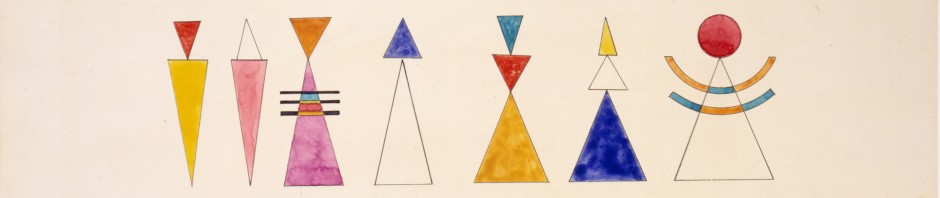
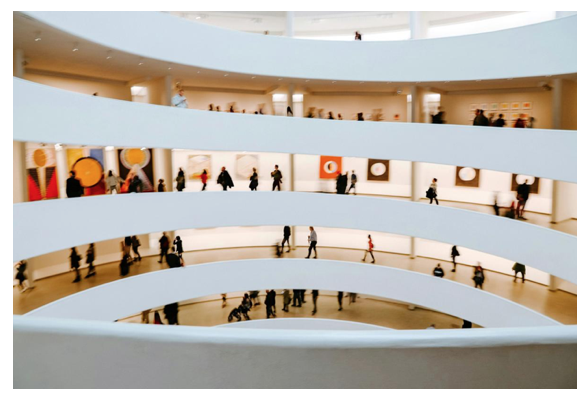
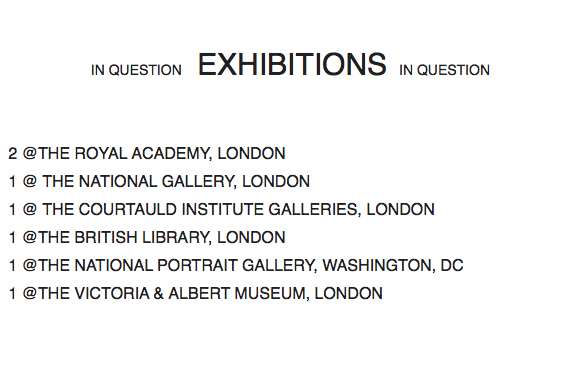

Many of the 65 pieces in the RA’s colourful show were loaned for this extraordinary exhibition in a desperate partnership between two Kyiv museums, the National Art Museum of Ukraine and the Museum of Theatre, Music and Cinema of Ukraine. After the War broke out in 2022, an ingenious plan was created both to safeguard these gems from destruction and to share them and their direct and indirect “messages’ internationally with the widest possible audience. Paintings have also been loaned by private collectors in support of this ambitious and prudent plan; many have rarely been seen in public, if at all.
Their arrival and display abroad, most recently at the Royal Academy, London, might be called a ‘miracle’ in light of their current status as “political refugees” that barely survived their removal from a warzone. The lorry transporting the artworks from the museum to the Polish border encountered first a bomb, and then a diplomatic holdup at the border!
The most comprehensive UK display to date of fine art in Ukraine, 1900-1939, this exhibition invites us to experience Ukraine through the eyes of its artists in the previous tumultuous period in their history leading up to the outbreak of WWII. In the past as now in the present, artists in Ukraine worked against a backdrop of enormous tension and chaos: collapsing empires, the First World War, the collapse of Empires, the fight for independence, and the traumatic establishment of Soviet Ukraine. Nevertheless, the stress of such nonstop events can be seen to have triggered a period of bold artistic expression and experimentation – a true flourishing of art, literature and theatre in Ukraine. In the Eye of the Storm highlights a range of artistic styles and cultural identities in the work of such talented artists as Kazymyr Malevych, Sonia Delaunay, Alexandra Exter and El Lissitzky, as well as lesser-known figures, each of whom has left an indelible mark on the country’s artistic and cultural heritage. Wildly dynamic and filled with a sense of both freedom and tension, many of them were confiscated or hidden from Soviet censors; indeed, some of these artists were forced to flee Ukraine to escape Stalin’s purges. Please join us in appreciation of the brilliance of the curators and directors, and the help of their willing staff and busdrivers who also showed such courage and creativity! The exhibition runs until 13 October 2024.
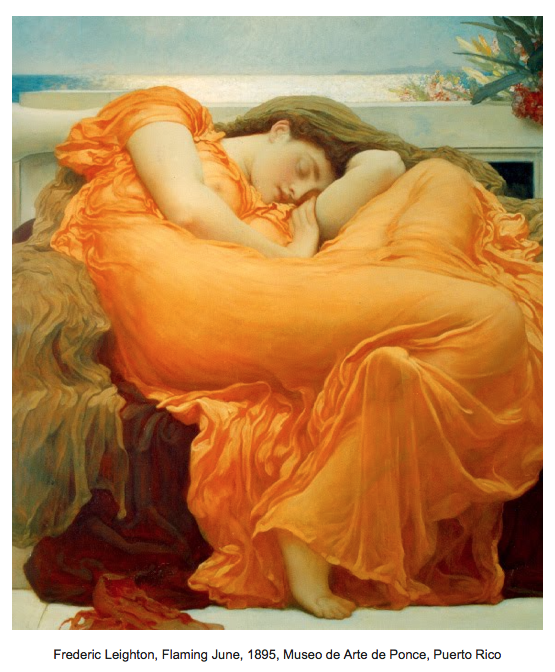
Samuel Courtauld, the most important collector of Impressionist and Post-Impressionist works in the UK, called it “the most wonderful painting in existence.” One of the most reproduced images in Victorian painting, Flaming June (1895) by Lord Frederic Leighton, was first displayed at the Royal Academy 129 years ago. His undisputed masterpiece, certainly his most sensual work, it is remarkable that it has been returned to the RA, on loan by a small museum in Puerto Rico, to serve as the centrepiece of a small but mighty exhibition in the Free Collection Gallery. There she both stands out as well as complements other works on display by Leighton, paintings by his contemporaries and by artists whom he in turn influenced. Nicholas will set Leighton’s work within the context of the key influences on Leighton: from the way he juxtaposes sculptural qualities with the precision of drawing, monumental sculpture with the fluidity of paint, and three-dimensional reality with two-dimensional representation. His bold use of colour puts him in a class with other intrepid colourists of his time, Gauguin, Van Gogh and Cezanne. Please join us for a lively Zoom Lecture. The exhibit runs until 12 January 2025, it is free, and no booking is required.
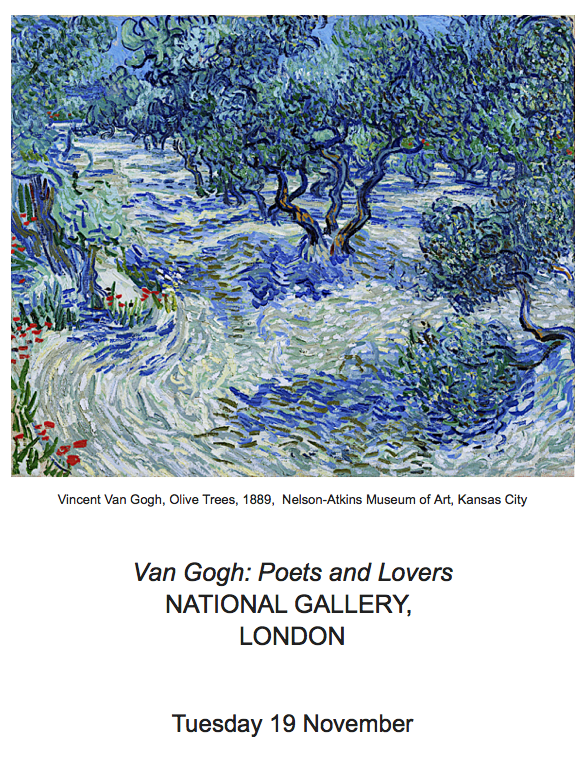
The National Gallery’s 200th anniversary gift to the nation is a once in a lifetime exhibition that brings together the most beloved of Van Gogh’s paintings from their own collection as well as major works from across the globe – some of which are rarely seen in public! They will be paired together with his extraordinary drawings offering a rare and fascinating opportunity to see Van Gogh’s process from sketch to completed painting.
Inspired by the light and long dry seasons of the Mediterranean climate of southern France – Arles and Saint-Rémy- he produced luminous landscapes of sheer poetic imagination. If you can get close enough to see his ‘Starry Night over the Rhône’ (1888, Musée d’Orsay) and ‘The Yellow House’ (1888, Van Gogh Museum), as well as NG’s own ‘Sunflowers’ (1888) and ‘Van Gogh’s Chair’ (1889), among many others. In just over two years in the south of France, Van Gogh completely revolutionised his style: from the sobriety of his early mid to late 1880’s work to an almost ecstatic quality through his use of bold colour applied with repetitive and rhythmic brush strokes. He so vividly saw the magic in landscapes and beauty in the ordinary! Tickets now available, booking through to 8 December. Exhibition runs to 19 January 2025.
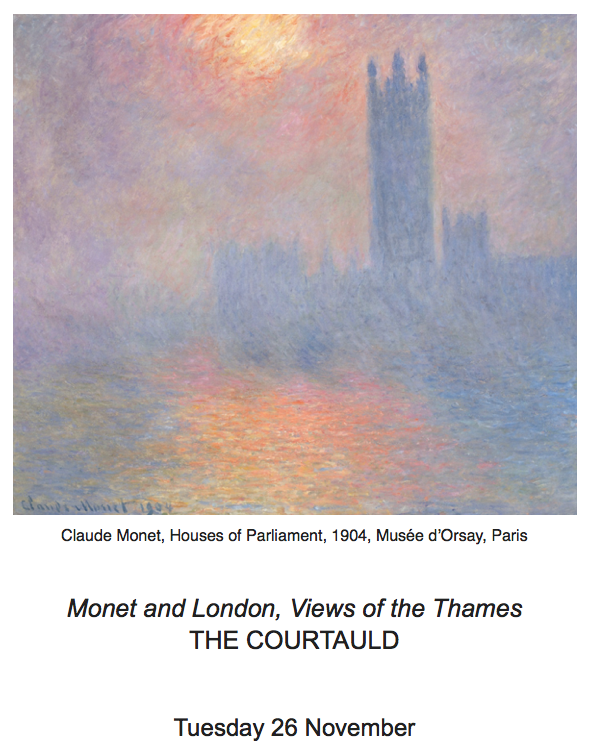
The grim industrial past of London’s South Bank is now almost entirely obliterated. However, when in 1899 Claude Monet first set up his easel on the balcony of his suite at the Savoy, his view – across the river now dominated by the Royal Festival Hall, the Hayward Gallery and the National Theatre – was a stinking crush of factories billowing filth, smoke and steam from giant chimneys. Yet for the visionary Monet the city’s mix of thick winter fog, sunlight and industrial pollution was irresistible, and he wrote to his wife Alice of “the amazing effects I have seen in the nearly two months that I have been constantly looking at this river Thames”. He unveiled the resulting series of 37 paintings depicting Charing Cross Bridge, Waterloo Bridge and the Houses of Parliament, in Paris in 1904. They depict extraordinary views of the Thames as it had never been seen before, or since, full of evocative atmosphere, mysterious light and, above all, most radiant and exquisite colour! Monet fervently wanted to show them in London the following year, but plans fell through. To this day, they have never been the subject of a UK exhibition. The Courtauld have taken it upon themselves brilliantly to realise Monet’s unfulfilled ambition of exhibiting this extraordinary group of paintings actually in London, and just 300 metres from the Savoy Hotel where many of them were painted! By presenting the paintings Monet himself selected for his public in Paris and London, the Courtauld offers us the experience of seeing the show Monet himself curated, with the works he felt best represented his artistic vision; brought together for the first time 120 years after their inaugural exhibition! The exhibition runs until 19 January 2025.
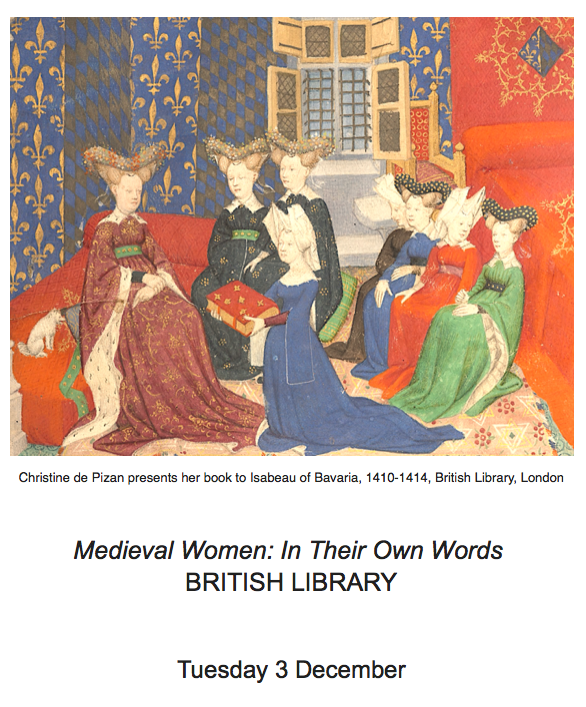
In an exhibition like no other before, the British Library offers an extraordinary window on the rich and complex lives of women in the Middle Ages through a display of over 140 rare items that reveal the artistry, the resourcefulness, the courage and the struggles of women, both those that achieved some measure of fame and those that didn’t. The exhibition’s highlights include: The Book of the Queen by Christine de Pizan, the first professional woman author in Europe; a 12th-century ivory cross belonging to Sibylle, countess of Flanders, who went on Crusade to the Holy Land; Julian of Norwich’s The Revelations of Divine Love, the first work in English definitely authored by a woman; a 15th-century birthing girdle; the Battel Hall retable, a rare surviving painting from a medieval English nunnery; and On Women’s Cosmetics, a recipe book likely to have been composed in Southern Italy in the 12th century with recipes for hair dye remover, face creams and breath freshener. In an enlivening departure from traditional narratives about medieval women the curators at the British Library have flushed out objects that narrate a more complete story of the experiences of medieval women. Issues familiar to women today – from the gender pay gap and harmful stereotypes, to impediments to healthcare and education, as well as challenges faced by female leaders – are also revealed by the reach of this very fine exhibition. The exhibition opens 25 October and continues until 2 March 2025.
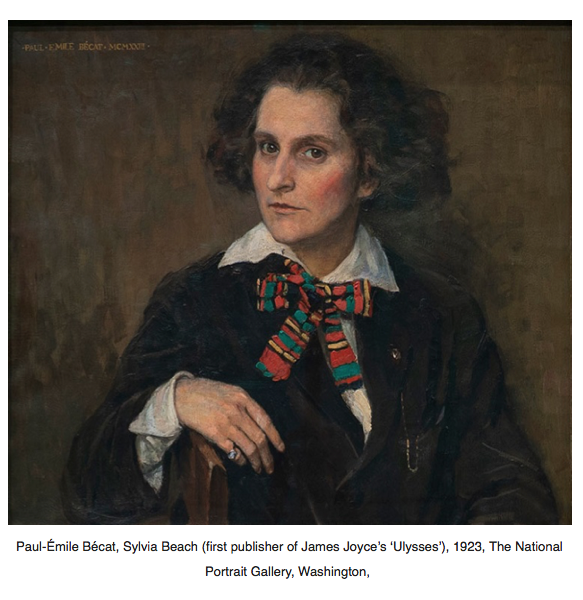
During the early decades of the twentieth century in the United States, and, to a lesser extent in Europe, Paris became a magnet for brilliant young women shocked by the extent of ‘coming of age’ restrictions. Escaping parental and societal constraints imposed on them, the exodus was most evident in the Northeastern United States, the region that after a painful labour, birthed the ‘Women’s Right to Vote’ Amendment to the American Constitution in 1920. Crossing the Atlantic – by steamship and later by plane, either alone or with a sympathetic friend or two – they each sought full emancipation from the social strata into which they were born with its concomitant segregation. The women in this important exhibition were desperate freely to pursue their professional passions, their educational and artistic aspirations, and their lifelong hopes and dreams for a fair chance at a self-determined life. These “Brilliant Exiles” took the boldest leap imaginable into a foreign culture, and found there the unfamiliar welcome of strangers. During those rare years in Paris, they experienced tolerances of their skin colour, of their gender, of their religion, of their education, even of their sexual preferences, freedom from both exclusion and entrapment. Once settled, they set about doing truly transformative work in wide-ranging fields including art, literature, dance, publishing, journalism, theatre, music, dance, interior design and fashion. This exhibition aims to enrich our understanding of a truly seminal period in history through an exhibition that retrieves from obscurity those whose achievements were undervalued; and those whose rational and intuitive perspectives were dismissed.
This important exhibition is on until February 23, 2025. NB: If you cannot visit the exhibition in person please consider obtaining the Yale University Press accompanying hardbound book of exquisite reproductions.
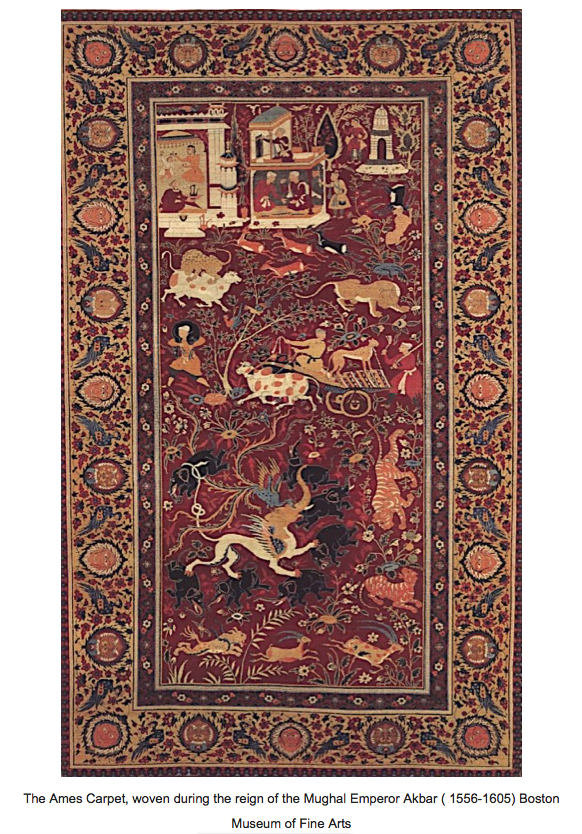
The V & A’s exhibition is the first in the UK to celebrate the creative output of the Golden Age of the Mughal Court (circa 1560 – 1660) during the reigns of its most famous and greatest Emperors Akbar, Jahangir and Shah Jahan. Shining a light on the internationalist culture of the great Persian-speaking courts, it combines artistic inspiration from Hindustani artists, Iranian masters and a handful of Europeans who together in the imperial workshops created a hybrid art of unparallelled beauty. The exhibition will showcase more than 200 objects including: rarely shown paintings, illustrated manuscripts, brilliantly coloured carpets, and delicate textiles, as well as architectural pieces and vessels made of mother of pearl, rock crystal and jade, and precious metals. On display in the U.K for the first time, will be the Ames carpet (c. 1590–1600) on loan from the Museum of Fine Arts, Boston. Woven in the imperial workshops, it is a statement of the interconnectedness of the arts during the years of the Mughal court. The exhibition, and this Lecture, aim to explore the very interesting question of the influence of European art on the workshops; how did the Moghul courts gain access to developments in the West? The exhibition opens 9 November 2024 and runs until 5 May 2025.
Booking Information:::::::::::::::::::::::::::::::::::::::::::::::::::::::::::::::::::::::::::
The Year in Question: 1776 has been developed by Louise Friend and will be presented by Nicholas Friend. It is held on Thursdays, beginning on Thursday 12 September 2024 at 5 pm and ending on Thursday 29 November 2024 at 5 pm. Please note the time of 5 pm: Nicholas will be lecturing from California (at 9 am his time) for the duration of this course.
You may choose to attend individual sessions or all twelve. If you book for the course but cannot manage a particular date, then be assured we will be sending recordings of sessions to all registered participants. Each session meets from 15 minutes before the advertised time of the lecture, and each lasts roughly one hour with 15 minutes discussion.
COST £50 per session, £600 for all twelve for members, £60 and £720 for all twelve for non-members. All sessions are limited to 21 participants to permit an after-lecture discussion session.
How to Set Up a PayPal account::::::::::::::::::::::::::::::::::::::::::::::::::::::::::::::
Click on this link: https://www.paypal.com/uk/home
In the upper right-hand corner of the screen, click “Sign up.”
On the following screen choose “Personal account” and click “Next.”
On the next page, you’ll be asked to enter your name, email address and to create and confirm a password. When finished, click “Next.”
Click “Agree and create account” and your PayPal account will be created.
How to Connect your Bank Account to your PayPal account:::::::::::::::::::::::
Log on to your account and click the “Wallet” option in the menu bar running along the top of the screen.
On the menu running down the left side of the screen, click the “Link a credit or debit card”.
Enter the card information you wish to link to your PayPal account and click “Link card” for debit card.
How to Send Money::::::::::::::::::::::::::::::::::::::::::::::::::::::::::::::::::::::::::::::::
Log on to your account. Click Send & Request.
Enter the email address of the person you wish to send money to: nicholas@inscapetours.co.uk
Type in the amount you wish to send, click continue then press ‘Send Money Now’.
 INSCAPE CULTURAL STUDY SOCIETY