
We put down roots. We each have a trunk. We speak of branch railway lines and branches of government, family trees, and leaves of grass and of books. We sometimes even ‘turn over a new leaf.’ Our language is rich with association between us and these gentle giants of the natural world. Numerous myths, ubiquitous in the annals of past and present civilizations, reflect an intimate connection between human beings and trees.
For those of us with awareness of our inner states, trees have extraordinary power to change our moods, even to shift our perspective on our worldly affairs. They can offer us a sense of stability, that is, a ‘rootedness’, a secure grounding in the moment. Standing silent as ancestral links to now invisible pre-agricultural, pre-industrial landscapes, we can be transfixed by single trees still standing as sentinels in the vastness of ancient park land.
Trees speak to us of constancy in adversity, the ability to ‘weather storms’ in our personal lives. In their antiquity, many trees have ‘seen’ events taking place long before we were born, thus setting our lives in the perspective of ancient history. The oldest large-scale living organism is a tree – ‘Methuselah’, a Great Basin bristlecone pine, is estimated to be 4,850 years old, older than Stonehenge. Numerous artists have celebrated the majesty of the solitary tree, from Constable’s extraordinary study of the trunk of an elm tree to the spreading single oaks of John Crome and the Barbizon school. Poets like Wordsworth, Coleridge and Matthew Arnold saw individual trees as settings for stirring emotional narratives.
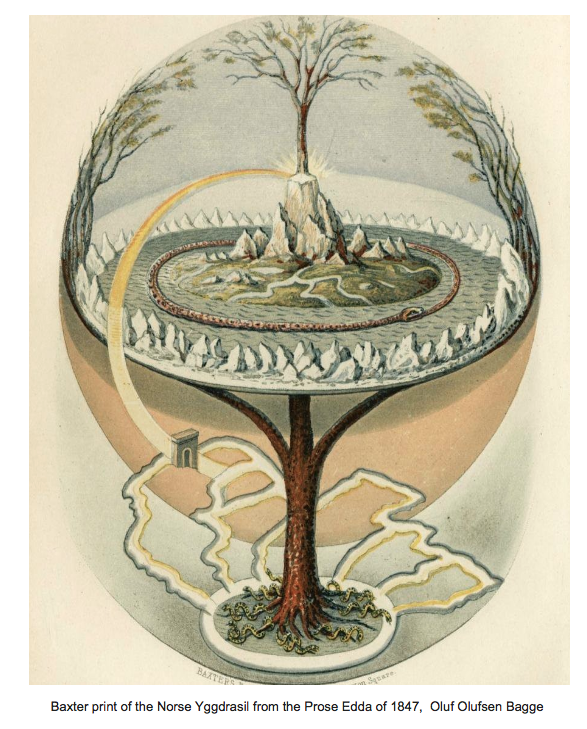
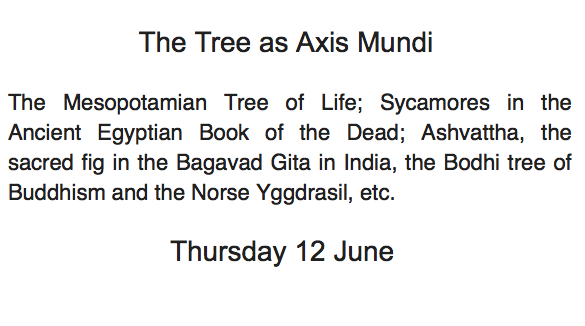
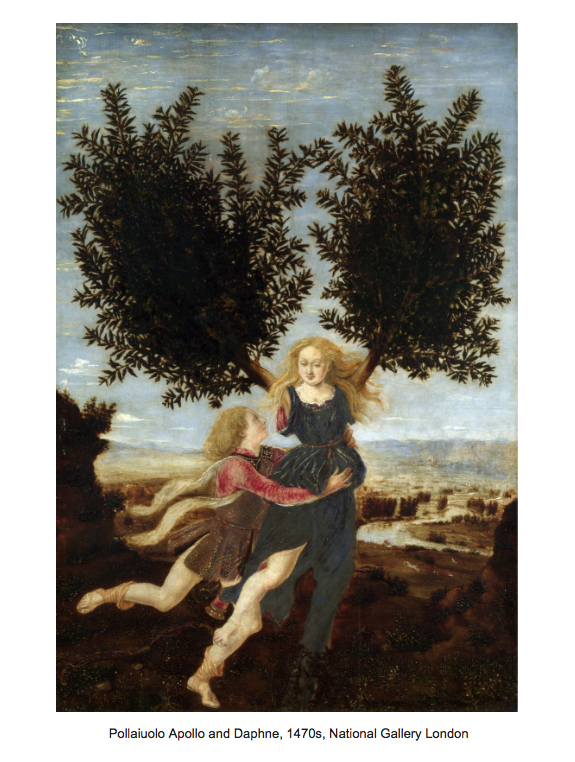
Even our mythologies and religions depend on trees: from the Tree of Knowledge of Good and Evil in Genesis to Yggdrasil, the Norse Tree of Life, an unimaginably vast ash tree in which all worlds nestle amid its branches and roots. The Egyptian Book of the Dead mentions sycamores as part of the scenery where the dead may find protection and food. Jewish people honour trees on Tu BiShvat, an ancient tradition celebrated by a day devoted to planting young trees and reverent feasts. The “Buddha’s tree,” under which the Buddha Siddhartha Gautama attained enlightenment, is a sacred fig tree which has accordingly become a symbol of enlightenment, wisdom, and spiritual awakening. Classical mythology declared that the garden of the Hesperides was dominated by a single tree bearing ‘Golden Apples’ that conferred immortality. Daphne escaped Apollo by being changed into a laurel. Christianity found the Tree of Jesse could express the descent of Jesus from the King of the Israelites, father of David. The cross of Jesus was cut from the wood of a tree purported to have once grown in the Garden of Eden.
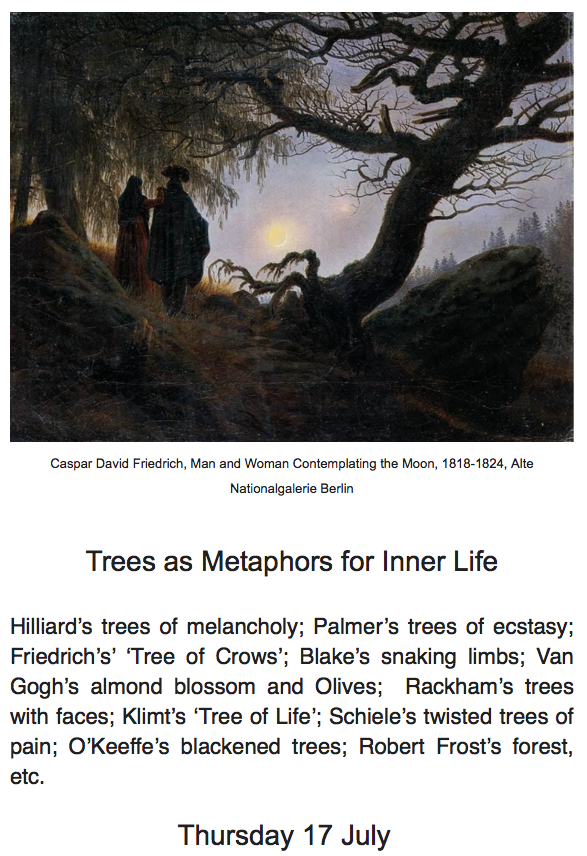
Trees have long been addressed by artists, from numerous depictions of the Temptation of Adam and Eve by Michelangelo and Cranach to the passionate sculpture of Bernini’s ‘Apollo and Daphne’ and on to the deep spiritual importance attached to olives by Van Gogh. The eternal pagan mystery of dark forests, where it seems that dryads still dwell, has been celebrated by artists and poets from Uccello to Harald Sohlberg to Robert Frost and Walter Crane.
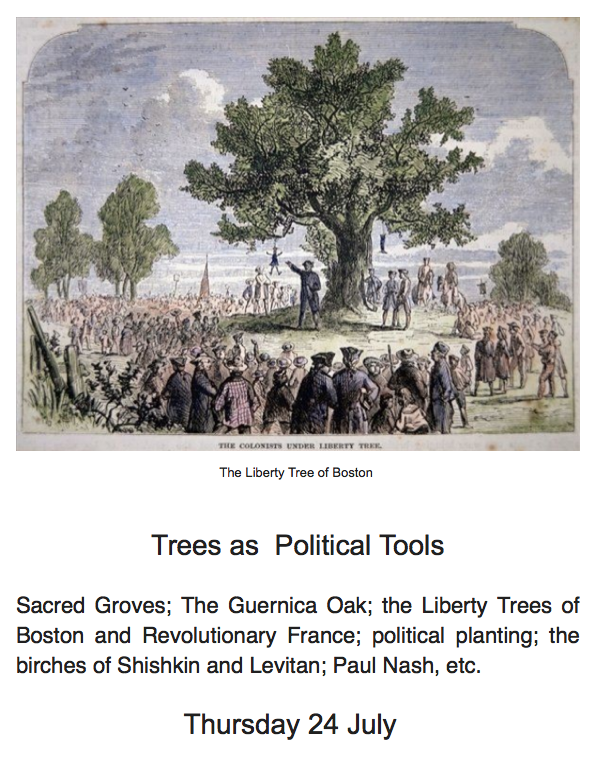
Trees have also taken on the mantle of symbolism for politicians and priests, whether Basques meeting under the oak of Guernica or druids meeting in sacred groves. The English gathered their patriotic fervour under William Boyce’s song ‘Heart of Oak’ of 1759, which then became the anthem of the Royal Navy. After the American Civil War, vast quantities of trees were planted in Washington DC to acclaim the survival of the Republic; its tree-lined avenues and streets softening with their windblown greenery the harsh vagaries of presidential politics. Russian and Scandinavian artists particularly celebrated the delicate birch as a national emblem. In the early 20c, groups of enlightened women engaged in major tree-planting campaigns to make a political statement against patriarchal indifference and brutality. Politicians of different persuasions engage in joint tree-planting exercises to signify that they are allies, who mean one another no harm. Chillingly, in Fascist Italy, Mussolini had all the trees in Rome ripped out save for the Italian pine, seen as the tree of the new Italian nation.
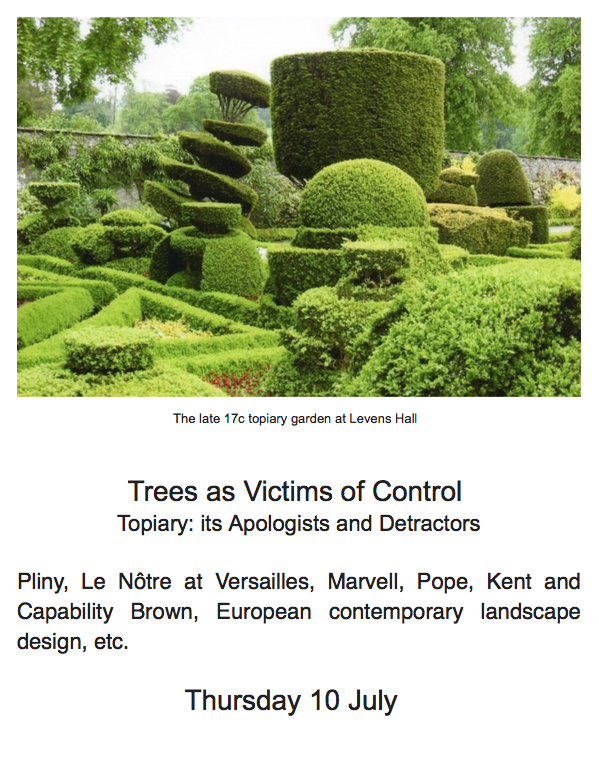
Gardeners often like to tame trees into topiary, and were much scorned by poets from Andrew Marvell to Alexander Pope. Some artists such as Mondrian and Magritte tamed their trees into geometries, while others from Constable to Van Gogh and Clare Cansick have celebrated their freedom from the axe and billhook-wielding hand of man. The paintings of Monet and the poetry of Gerard Manley Hopkins have forever immortalised transitory crop-trees like poplars, while photography of trees by such geniuses as Carleton Watkins and Ansel Adams did much to further the conservation movement of Ruskin and his disciple John Muir.
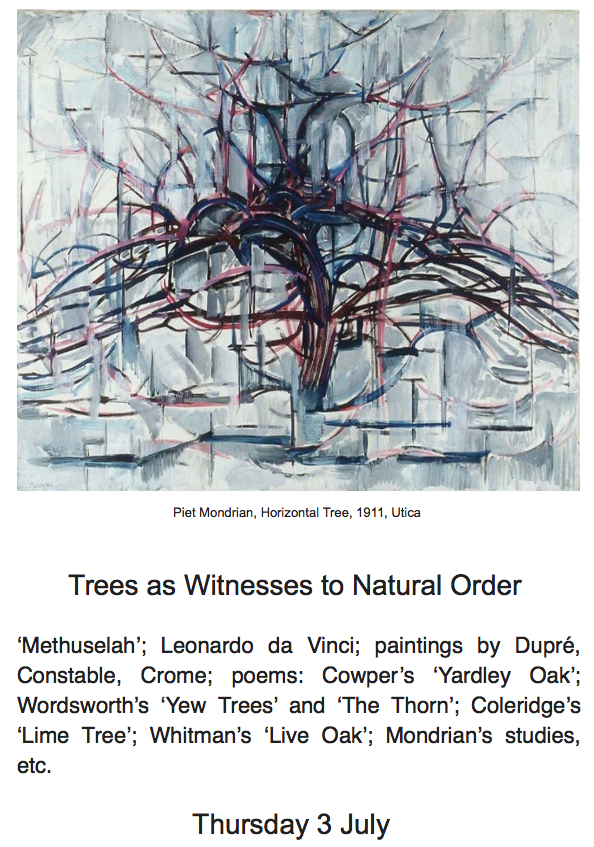
For modernist painters like the Fauves, Derain, Braque and Manguin, trees became a kind of laboratory in which they could experiment with colours never before associated with trees, such as red trunks, colours which nonetheless celebrate the artists’ passions. Klimt found in trees a natural echo of the mosaics he applied to his portraits. Mondrian found a geometry in trees, which he simplified and simplified until the depicted tree became a source for his later abstract rectangles.
Trees have always been most vital companions, stalwart in their presence, while silently removing harmful carbon dioxide from the air we pollute, and delivering us, and all green and growing things, life-affirming oxygen. This course is conceived as an Inscape celebration of trees aided by the minds, eyes and hands of great artists, writers, poets, and composers. Please do join us if you can!



Booking Information:::::::::::::::::::::::::::::::::::::::::::::::::::::::::::::::::::::::::::
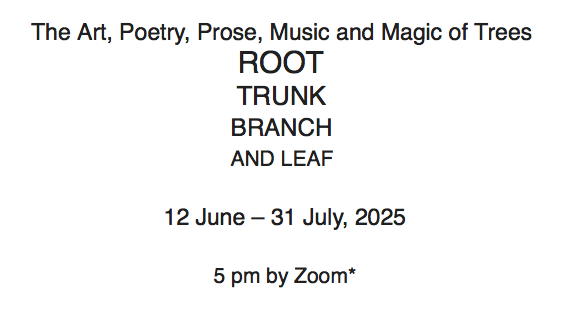
‘The Art, Poetry, Prose, Music and Magic of Trees’ is a Zoom course ( * for which we offer support to access) which has been developed by Louise Friend and will be presented by Nicholas Friend. It is held on Thursdays, beginning on Thursday 12 June 2025 at 5pm and ending on Thursday 31 July 2025 at 5pm. Please note the time of 5pm: Nicholas will be lecturing from California (at 9am his time) for the duration of this course.
If you book for the course but cannot manage a particular date, then be assured we will be sending recordings of sessions to all registered participants. Each session meets from 15 minutes before the advertised time of the lecture, and each lasts roughly one hour with 15 minutes discussion.
COST: £400 for all eight for members, £480 for all eight for non-members. All sessions are limited to 21 participants to permit an after-lecture discussion session.
Please make your payment to Friend&Friend Ltd by bank transfer to our account with Metrobank, bank sort code 23-05-80, account number 13291721 or via PayPal to nicholas@inscapetours.co.uk, or credit/debit card by phone to Henrietta on 07940 719 397. She is available on Tuesdays or Thursdays between 2-5 pm.
How to Set Up a PayPal account::::::::::::::::::::::::::::::::::::::::::::::::::::::::::::::
Click on this link: https://www.paypal.com/uk/home
In the upper right-hand corner of the screen, click “Sign up.”
On the following screen choose “Personal account” and click “Next.”
On the next page, you’ll be asked to enter your name, email address and to create and confirm a password. When finished, click “Next.”
Click “Agree and create account” and your PayPal account will be created.
How to Connect your Bank Account to your PayPal account:::::::::::::::::::::::
Log on to your account and click the “Wallet” option in the menu bar running along the top of the screen.
On the menu running down the left side of the screen, click the “Link a credit or debit card”.
Enter the card information you wish to link to your PayPal account and click “Link card” for debit card.
How to Send Money::::::::::::::::::::::::::::::::::::::::::::::::::::::::::::::::::::::::::::::::
Log on to your account. Click Send & Request.
Enter the email address of the person you wish to send money to: nicholas@inscapetours.co.uk
Type in the amount you wish to send, click continue then press ‘Send Money Now’.
 INSCAPE CULTURAL STUDY SOCIETY